Please select a subject first
Advertisements
Advertisements
The main objective of United Nations is to ______.
Concept: Evolution of the UN
Assertion (A): The United Nations is expected to cope better with the Unipollar World.
Reason (R): After the disintegration of Soviet Union many new countries joined the United Nations.
Concept: The UN in a Unipolar World
Why did India not sign the nuclear treaties like NPT and CTBT ? Explain any two reasons.
Concept: India's Nuclear Policy
In the given political outline map of India, four countries/states have been marked as A, B, C and D. Identify these on the basis of the information given below and write their correct names in your answer book along with their respective serial number of the information used and the concerned alphabet as per format that follows:
- The country with which India fought a battle in 1962.
- The country with which India has a dispute.
- The country which came into existence after the 1971 war.
- The Indian state which shares its border with China.
| S.No. of the Information used |
Concerned Alphabet in the map |
Name of the Countries/States |
| (i) | ||
| (ii) | ||
| (iii) | ||
| (iv) |
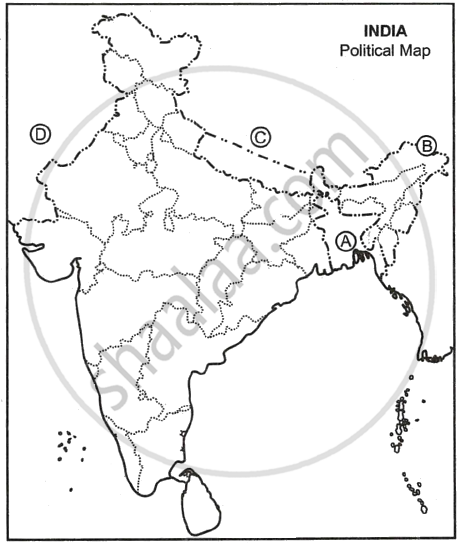
Concept: Wars and Peace with Pakistan
Explain, any four criteria proposed for new permanent and non-permanent members of the UN Security Council.
Concept: Reform of Structures and Processes
Explain any two functions of International Labour Organisation (ILO).
Concept: Rise of New International Actors - New International Economic Organisations, Ngos
Explain any four components of India’s security strategy.
Concept: India’s Security Strategy
Examine the major issues which led to the split of Congress part in 1969.
Concept: Congress Split and Reconstitution
Describe the security challenges faced by the newly independent countries of Asia and Africa after the Second World War.
Concept: Traditional Concerns of Security and Politics of Disarmament
Highlight the importance of the strategy of 'Non-Congressism' forwarded by Ram Manohar Lohia in the 1967 general election.
Concept: Fourth General Elections, 1967
Why is the Presidential election in 1969 in India considered 'Historical'?
Concept: Split in the Congress
Which one of the following is a concern under Traditional Security?
Concept: Traditional Notions: External
Assertion (A): In 1969 the Congress Party faced a split.
Reason (R): Factional rivalry existed between the Congress Syndicate and Indira Gandhi.
Concept: Split in the Congress
Arrange the following in the chronological order:
- Appointment of Lal Bahadur Shastri as Prime Minister.
- Tashkent Agreement.
- The fourth General Elections.
- Election of V.V. Giri as the President of India.
Concept: Political Succession After Nehru
Explain terrorism as a new source of threat to the security with the help of any two examples.
Concept: New Sources of Threats
In the given outline political map of India, four states have been marked as A, B, C, and D. With the help of the information given below, identify them and write their correct names in your answer book along with the serial number of the information used and the related alphabet in the map as per the format given below:

- The state to which Jai Prakash Narain belonged.
- The State where the Indian National Congress won most of the Lok Sabha seats in the 1977 elections.
- The State from where Raj Narain contested the Lok Sabha seat against Indira Gandhi in the 1977 election.
- The State where Janata Party won all the Lok Sabha seats in the 1977 election.
S. No. of the Information used Related alphabet is given in the MAP. Name of the State (i) ______ ______ (ii) ______ ______ (iii) ______ ______ (iv) ______ ______
Concept: 1977 Elections and the Formation of Janata Party
Explain the concept of 'Total Revolution' advocated by Jayaprakash Narayan.
Concept: Navnirman Movement in Gujarat and the Bihar Movement
Which of the following resources is not a global common?
Concept: The Protection of Global Commons
Who among the following had announced a nationwide satyagraha on 25th June, 1975 for the resignation of Prime Minister Indira Gandhi?
Concept: Background to Emergency
"Development mostly causes degradation of environment." Justify the statement referring to two environmental movements.
Concept: Environment Movements: One Or Many?
