Advertisements
Advertisements
प्रश्न
If a line makes angles 90° and 60° respectively with the positive directions of x and y axes, find the angle which it makes with the positive direction of z-axis.
Advertisements
उत्तर
Let the direction cosines of the line be l, m and n.
We know that l2 + m2 + n2 = 1.
Let the line make angle θ with the positive direction of the z-axis.
α=90°, β=60°, γ=Θ
So, cos290°+cos260°+cos2θ=1
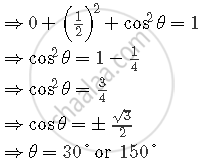
APPEARS IN
संबंधित प्रश्न
If sin [cot−1 (x+1)] = cos(tan−1x), then find x.
Evaluate the following:
`tan^-1(tan pi/3)`
Evaluate the following:
`sec^-1(sec (5pi)/4)`
Evaluate the following:
`sec^-1(sec (7pi)/3)`
Write the following in the simplest form:
`tan^-1{(sqrt(1+x^2)+1)/x},x !=0`
Write the following in the simplest form:
`sin^-1{(x+sqrt(1-x^2))/sqrt2},-1<x<1`
Evaluate the following:
`tan(cos^-1 8/17)`
Prove the following result-
`tan^-1 63/16 = sin^-1 5/13 + cos^-1 3/5`
Evaluate:
`sin(tan^-1x+tan^-1 1/x)` for x > 0
Solve the following equation for x:
`tan^-1 2x+tan^-1 3x = npi+(3pi)/4`
Sum the following series:
`tan^-1 1/3+tan^-1 2/9+tan^-1 4/33+...+tan^-1 (2^(n-1))/(1+2^(2n-1))`
Evaluate the following:
`tan 1/2(cos^-1 sqrt5/3)`
`tan^-1 2/3=1/2tan^-1 12/5`
`tan^-1 1/7+2tan^-1 1/3=pi/4`
`4tan^-1 1/5-tan^-1 1/239=pi/4`
Solve the following equation for x:
`3sin^-1 (2x)/(1+x^2)-4cos^-1 (1-x^2)/(1+x^2)+2tan^-1 (2x)/(1-x^2)=pi/3`
If `sin^-1x+sin^-1y+sin^-1z=(3pi)/2,` then write the value of x + y + z.
If x < 0, then write the value of cos−1 `((1-x^2)/(1+x^2))` in terms of tan−1 x.
Write the value of cos−1 \[\left( \cos\frac{5\pi}{4} \right)\]
If \[\tan^{- 1} (\sqrt{3}) + \cot^{- 1} x = \frac{\pi}{2},\] find x.
Write the value of \[\tan\left( 2 \tan^{- 1} \frac{1}{5} \right)\]
Write the principal value of `tan^-1sqrt3+cot^-1sqrt3`
Write the principal value of \[\sin^{- 1} \left\{ \cos\left( \sin^{- 1} \frac{1}{2} \right) \right\}\]
Wnte the value of\[\cos\left( \frac{\tan^{- 1} x + \cot^{- 1} x}{3} \right), \text{ when } x = - \frac{1}{\sqrt{3}}\]
The number of real solutions of the equation \[\sqrt{1 + \cos 2x} = \sqrt{2} \sin^{- 1} (\sin x), - \pi \leq x \leq \pi\]
Find : \[\int\frac{2 \cos x}{\left( 1 - \sin x \right) \left( 1 + \sin^2 x \right)}dx\] .
Find the domain of `sec^(-1) x-tan^(-1)x`
Find the simplified form of `cos^-1 (3/5 cosx + 4/5 sin x)`, where x ∈ `[(-3pi)/4, pi/4]`
The value of sin `["cos"^-1 (7/25)]` is ____________.
