Please select a subject first
Advertisements
Advertisements
The shiny outer surface of a hollow sphere of aluminium of radius 50 cm is to be used as a mirror:
Which type of spherical mirror will it provide?
Concept: Spherical Mirrors
Define the following terms in the context of spherical mirrors :
(i) Pole
(ii) Centre of curvature
(iii) Radius of curvature
(iv) Principal axis
Concept: Spherical Mirrors
An optical device has been given to a student and he determines its focal length by focusing the image of the sun on a screen placed 24 cm from the device on the same side as the sun. Select the correct statement about the device.
(A) Convex mirror of focal length 12 cm
(B) Convex lens of focal length 24 cm
(C) Concave mirror of focal length 24 cm
(D) Convex lens of focal length 12 cm
Concept: Spherical Mirrors
AB and CD, two spherical mirrors, from parts of a hollow spherical ball with its centre at O as shown in the diagram. If arc AB = `1/2` arc CD, what is the ratio of their focal lengths? State which of the two mirrors will always form virtual image of an object placed in front of it and why.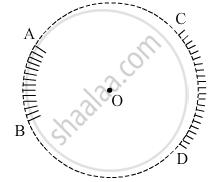
Concept: Spherical Mirrors
Name the type of lens whose power is positive.
The image of an object formed by a lens is real, inverted and of the same size as the object. If the image is at a distance of 40 cm from the lens, what is the nature and power of the lens ? Draw ray diagram to justify your answer.
Concept: Power of a Lens
A student obtained on a screen the sharp image of a candle flame placed at the farther end of laboratory table using a concave mirror. For getting better value of focal length of the mirror, the teacher suggested to him to focus the sun. What should the student do?
(A) Should move the mirror away from the screen.
(B) Should move the mirror towards the screen.
(C) Should move the mirror and screen both towards the sun.
(D) Should move only the screen towards the sun.
Concept: Spherical Mirrors
State the types of mirrors used for (i) headlights and (ii) rear view mirror, in cars and motorcycles. Give to justify your answer in each case.
Concept: Spherical Mirrors
State the two laws of reflection of light.
Concept: Law of Reflection of Light
Mohan obtained a sharp inverted image of a distant tree on the screen placed behind the lens. He then moved the screen and tried to look through the lens in the direction of the object. He would see:
(1) a blurred image on the wall of the laboratory.
(2) an erect image of the tree on the lens.
(3) no image as the screen has been removed
(4) an inverted image of the tree at the focus of the lens.
Concept: Power of a Lens
What is atmospheric reflection? Explain with the help of a labelled diagram that the position of a star as seen by us is not its true position.
Concept: Refraction of Light
List four characteristics of the image formed by a concave lens of focal length 20 cm when the object is placed at a distance of 40 cm from its optical centre.
Concept: Refraction of Light
The size of image of an object by a convex lens of focal length 20 cm is observed to be reduced to `1/3` rd of its size . Find the distance of the object from the optical centre of the lens .
Concept: Refraction of Light
List in proper sequence the steps of the experiment for determining the approximate focal length of a given concave mirror by obtaining the image of a distant object.
Concept: Refraction of Light
A real image is formed by the light rays after reflection or refraction when they:
- actually meet or intersect with each other.
- actually converge at a point.
- appear to meet when they are produced in the backward direction.
- appear to diverge from a point.
Which of the above statements are correct?
Concept: Refraction of Light
Answer the following question.
Write the modification in the curvature of the eye lens which enables us to see the nearby objects clearly?
Concept: Spherical Mirrors
In torches, search lights and headlights of vehicles the bulb is placed ______.
Concept: Spherical Mirrors
An object is kept at a distance of 1m from a lens of power +2D:
- Identify the type of lens.
- Calculate its focal length and distance of the image formed.
Concept: Power of a Lens
What is atmospheric refraction? Use this phenomenon to explain the following natural events:
Advanced sun-rise and delayed sun-set.
Draw diagrams to illustrate your answers.
Concept: Atmospheric Refraction
In the following ray diagram the correctly marked angle are:

(a) ∠i and ∠e
(b) ∠A and ∠D
(c) ∠i, ∠e and ∠D
(d) ∠r, ∠A and ∠D
Concept: Dispersion of Light Through a Prism
A person needs a lens of power -5.5 dioptres for correcting his distant vision. For correcting his near vision he needs a lens of power +1.5 dioptre. What is the focal length of the lens required for correcting (i) distant vision and (ii) near vision?
Concept: Defects of Vision and Their Corrections > Presbyopia
