Definitions [14]
When a body oscillates under the influence of an external periodic force, not with its own natural frequency but with the frequency of the external periodic force, its oscillations are called forced oscillations.
The particular case of forced oscillations in which the frequency of the driving force equals the natural frequency of the oscillator, and the amplitude of oscillations is very large — such oscillations are called resonant oscillations and the phenomenon is called resonance.
The motion which repeats itself after equal intervals of time is called periodic motion.
The periodic (to and fro) and bounded motion of a body about a fixed point is called oscillatory motion.
When a body, capable of oscillation, is slightly displaced from its position of equilibrium and left to itself, it starts oscillating with a frequency of its own — such oscillations are called free oscillations.
The oscillations in which the amplitude decreases gradually with the passage of time are called damped oscillations.
When energy is continuously supplied from outside to an oscillating system at the same rate at which energy is lost, so that the amplitude remains constant, such oscillations are called maintained oscillations.
If the restoring force/torque acting on a body in oscillatory motion is always directly proportional to its displacement from the equilibrium position and directed towards it, then the motion is called simple harmonic motion (SHM).
Define the time period of simple harmonic motion.
Time period: The time period is defined as the time taken by a particle to complete one oscillation. It is usually denoted by T. For one complete revolution, the time taken is t = T, therefore,
`ω"T"` = 2π ⇒ T = `(2π)/ω`
Define the frequency of simple harmonic motion.
The number of oscillations produced by the particle per second is called frequency. It is denoted by f. SI unit for frequency is s−1 or hertz (Hz).
Mathematically, frequency is related to the time period by f = `1/"T"`
Any function that repeats itself at regular intervals of its argument is called a periodic function.
The physical quantity which represents the position and direction of motion at any instant of the particle executing SHM is called phase.
The constant φ in the equation of SHM x = Acos(ωt + ϕ) is called phase constant or initial phase.
Define linear S.H.M.
Linear S.H.M. is defined as the linear periodic motion of a body in which the restoring force (or acceleration) is always directed towards its mean position and its magnitude is directly proportional to the displacement from the mean position.
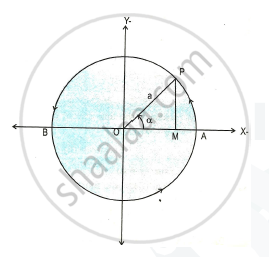
Consider a particle ‘P’ moving along the circumference of a circle of radius 'a' and centre O, with uniform angular speed of 'ω' in anticlockwise direction as shown.
Particle P along the circumference of the circle has its projection particle on diameter AB at point M.
Key Points
- When a particle is subjected simultaneously to two SHMs having the same period and along the same path, the resultant motion is also SHM along the same path.
- The resultant displacement of the particle at any instant is equal to the vector sum of its individual displacements due to both the SHMs at that instant.
Important Questions [44]
- A copper metal cube has each side of length 1 m. The bottom edge of the cube is fixed and tangential force 4.2x10^8 N is applied to a top surface.
- What is the Periodic Time (T) of that Pendulum Which is Suspended in an Elevator Moving with Constant Speed in Downward Direction
- The Periodic Time of a Linear Harmonic Oscillator is 2π Second, with Maximum Displacement of 1 Cm.
- A Body of Mass 1 Kg is Mafe to Oscillate on a Spring of Force Constant 16 N/M. Calculate (A) Angular Frequency, (B) Frequency of Vibrations.
- The Length of the Second’S Pendulum in a Clock is Increased to 4 Times Its Initial Length. Calculate the Number of Oscillations Completed by the New Pendulum in One Minute.
- Derive an Expression for the Period of Motion of a Simple Pendulum. On Which Factors Does It Depend?
- State the Differential Equation of Linear Simple Harmonic Motion.
- The average displacement over a period of S.H.M. is ______. (A = amplitude of S.H.M.)
- Show Variation of Displacement, Velocity and Acceleration with Phase for a Particle Performing Linear S.H.M. Graphically, When It Starts from Extreme Position.
- Define Phase of S.H.M.
- A Body of Mass 1 Kg is Made to Oscillate on a Spring of Force Constant 16 N/M. Calculate: Angular Frequency Frequency of Vibration.
- A Particle Executes S.H.M. with a Period of 10 Seconds. Find the Time in Which Its Potential Energy Will Be Half of Its Total Energy.
- Assuming the Expression for Displacement of A Particle Starting from Extreme Position, Explain Graphically the Variation of Velocity And Acceleration W.R.T. Time.
- In a Damped Harmonic Oscillator, Periodic Oscillations Have___ Amplitude.
- Calculate the Acceleration When It is at 4 Cm from Its Positive Extreme Position.
- Hence Obtain the Expression for Acceleration, Velocity and Displacemetn of a Particle Performing Linear S.H.M.
- A Particle Performing Linear S.H.M. Has a Period of 6.28 Seconds and a Pathlength of 20 cm. What is the Velocity When Its Displacement is 6 cm from Mean Position?
- Define linear S.H.M.
- The Maximum Velocity of a Particle Performing Linear S.H.M. is 0.16 m/s. If Its Maximum Acceleration is 0.64 m/s^2, Calculate Its Period.
- Two Particles Perform Linear Simple. Harmonic Motion Along the Same Path of Length 2a and Period T as Shown In the Graph Below. the Phase Difference Between Them is
- Obtain the differential equation of linear simple harmonic motion.
- A Particle Executing Linear S.H.M. Has Velocities V1 and V2 at Distances X1 and X2 Respectively from the Mean Position. the Angular Velocity of the Particle is
- A Particle Performing Linear S.H.M. Has the Maximum Velocity of 25 Cm/S and Maximum Acceleration of 100 Cm/ M2. Find the Amplitude and Period of Oscillation.
- From Differential Equation of Linear S.H.M., Obtain an Expression for Acceleration, Velocity and Displacement of a Particle Performing S.H.M.
- In SI units, the differential equation of an S.H.M. is (d^2x)/(dt^2) = − 36x. Find its frequency and period.
- A particle performing Linear S.H.M. has a maximum velocity 25 cm/sand maximum acceleration 100 cm/s2. Find the period of oscillations.
- The Number of Degrees of Freedom for a Rigid Diatomic Molecule is
- The Pressure (P) of an Ideal Gas Having Volume (V) is 2E/3V , Then the Energy E is
- Calculate the Kinetic Energy of 10 Gram of Argon Molecules At 127°C.
- Prove the Law of Conservation of Energy for a Particle Performing Simple Harmonic Motion. Hence Graphically Show the Variation of Kinetic Energy and Potential Energy W. R. T.
- The Kinetic Energy of Nitrogen per Unit Mass at 300 K is 2.5 × 10⁶ J/Kg. Find the Kinetic Energy of 4 Kg Oxygen at 600 K. (Molecular Weight of Nitrogen = 28, Molecular Weight of Oxygen = 32)
- Obtan an Expression for Potential Energy of a Particle Performing S.H.M. What is the Value of Potential Energy at (I) Mean Position, and (Ii) Extreme Position
- State an Expression for K. E. (Kinetic Energy) and P. E. (Potential Energy) at Displacement ‘X’ for a Particle Performing Linear S.H. M. Represent Them Graphically.
- Obtain an Expression for Potential Energy of a Particle Performing Simple Harmonic Motion. Hence Evaluate the Potential Energy
- Calculate the Average Molecular Kinetic Energy : (A) per Kilomole, (B) per Kilogram, of Oxygen at 27°C.
- The period of a conical pendulum in terms of its length (l), semi-vertical angle (θ) and acceleration due to gravity (g) is ______.
- Show that Motion of Bob of the Pendulum with Small Amplitude is Linear S.H.M. Hence Obtain an Expression for Its Period. What Are the Factors on Which Its Period Depends?
- Show That, Under Certain Conditions, Simple Pendulum Performs the Linear Simple Harmonic Motion.
- If the Particle Starts Its Motion from Mean Position, the Phase Difference Between Displacement and Acceleration is ______.
- Define Practical Simple Pendulum
- The Phase Difference Between Displacement and Acceleration of a Particle Performing S.H.M. is
- If the Metal Bob of a Simple Pendulum is Replaced by a Wooden Bob of the Same Size, Then What is Effect on Time Period
- When the Length of a Simple Pendulum is Decreased by 20 Cm, the Period Changes by 10%. Find the Original Length of the Pendulum.
- A Clock Regulated by Seconds Pendulum, Keeps Correct Time. During Summer, Length of Pendulum Increases to 1.005 M. How Much Will the Clock Gain Or Loose in One Day?
Concepts [8]
- Periodic and Oscillatory Motion
- Simple Harmonic Motion (S.H.M.)
- Differential Equation of Linear S.H.M.
- Projection of U.C.M.(Uniform Circular Motion) on Any Diameter
- Phase of K.E (Kinetic Energy)
- K.E.(Kinetic Energy) and P.E.(Potential Energy) in S.H.M.
- Composition of Two S.H.M.’S Having Same Period and Along Same Line
- Some Systems Executing Simple Harmonic Motion
