Definitions [13]
The phenomenon in which electric current is generated in a conductor or closed coil due to a varying magnetic field is called electromagnetic induction.
Magnetic flux linked with any surface is equal to the total number of magnetic lines of force passing normally through it.
Magnetic flux (ΦB) is the measure of magnetic field lines passing through a surface.
Define the right-hand thumb rule.
If the current-carrying conductor is held in the right hand such that the thumb points in the direction of the current, then the direction of the curl of the fingers will give the direction of the magnetic field.
Whenever the number of magnetic lines of force (magnetic flux) passing through a coil changes, an electric current is induced in the coil. This current is called the induced current.
The electromotive force induced in a conductor when it moves through a magnetic field, causing a change in magnetic flux through the circuit it completes.
The phenomenon of electromagnetic induction in which a change in current through a coil induces an EMF in the same coil, opposing the change in current, is called self-induction.
The self-inductance of a coil is defined as the ratio of the total magnetic flux linkage to the current flowing through it.
The work done by the source in establishing a current I against the self-induced back-emf, which is stored as magnetic potential energy in the inductor's magnetic field.
The magnetic energy stored per unit volume of space in the magnetic field region.
The property of two coils by which a change in current in one coil induces an emf in the other coil — equal to the magnetic flux linked with one circuit per unit current in the other, or the value of induced emf produced in the secondary circuit per unit rate of change in current in the primary circuit — is called mutual inductance.
OR
Mutual Inductance (M) of a pair of coils is defined as the ratio of the total magnetic flux linkage in the secondary coil to the current in the primary coil that produces it.
The coefficient of coupling K between two coils is the fraction of the total magnetic flux produced by one coil that links with the other coil.
Define mutual inductance.
The mutual inductance (M) of two circuits (or coils) is the magnetic flux (Φs) linked with the secondary circuit per unit current (IP) of the primary circuit.
Eddy currents are circulating currents induced in the bulk of a conductor when the magnetic flux linked with it changes.
They are named after the whirlpool-like eddies formed in flowing water.
Formulae [8]
For a uniform magnetic field and a plane surface,
Where:
| Symbol | Meaning |
|---|---|
| ΦB | Magnetic flux |
| \[\vec B\] | Magnetic field |
| \[\vec A\] | Area vector of the surface |
| A | Area of the surface |
| θ | Angle between \[\vec B\] and \[\vec A\] |
For a non-uniform magnetic field or a curved surface, divide the surface into very small area elements \[d\vec A\].
\[{\Phi_B=\int\vec{B}\cdot d\vec{A}}\]
For a coil of N turns, when every turn contributes equally,
\[{\Phi=NBA\cos\theta}\]
This is the magnetic flux linkage of the coil.
If a coil has N turns and the magnetic flux through it changes by ΔΦB in time Δt, the induced emf is:
\[{\varepsilon=-N\frac{\Delta\Phi_B}{\Delta t}}\]
For a coil of area A placed in a uniform magnetic field B, the magnetic flux is given by:
- \[\Phi=\vec{B}\cdot\vec{A}\]
- \[{\Phi=BA\cos\theta}\]
where θ is the angle between the area vector \[\vec A\] and the magnetic field \[\vec B\].
NΦB = LI
Where:
- N = number of turns
- ΦB = magnetic flux linked per turn
- I = current flowing through the coil
- L = coefficient of self-inductance (self-inductance)
N2ϕ21 ∝ I1 ⟹ N2ϕ21 = M ⋅ I1
Therefore:
M = K\[\sqrt {L_1L_2}\]
Where:
- L1, L2 = Self-inductances of coil 1 and coil 2
- K = Coefficient of coupling (dimensionless, no units)
- Range: 0 ≤ K ≤ 1
Therefore:
M ≤ \[\sqrt {L_1L_2}\]
Theorems and Laws [6]
State Faraday’s laws of electromagnetic induction.
First law: Whenever there is a change of magnetic flux in a closed circuit, an induced emf is produced in the circuit. This law is a qualitative law as it only indicates the characteristics of induced emf.
Second law: The magnitude of the induced emf produced in the circuit is directly proportional to the rate of change of the magnetic flux linked with the circuit. This law is known as the quantitative law, as it gives the magnitude of the induced emf.
Faraday’s First Law: Whenever the magnetic flux linked with a circuit changes, an emf is induced in the circuit.
Faraday’s Second Law: The magnitude of the induced emf is equal to the rate of change of magnetic flux.
e = `-(d phi)/dt`
For a coil of N turns:
e = `-N (d phi)/dt`
Negative sign indicates Lenz’s law (direction opposes cause).
State Lenz’s Law.
It is stated that the direction of induced e.m.f. is always in such a direction that it opposes the change in magnetic flux.
e = `(d phi)/(dt)`
Consider a rectangular metal coil PQRS. Let ‘L’ be the length of the coil. It is placed in a partly magnetic field ‘B’. The direction of the magnetic field is perpendicular to the paper and into the paper. The ‘x’ part of the coil is in the magnetic field at instant t. If the coil is moved towards the right with a velocity v = `dx/dt` with the help of an external agent, such as a hand. The magnetic flux through the coil is:
Φ = BA = BLx
∴ Φ = BLx ...(1)
There is relative motion of a current through the coil. Let ‘i’ be current through the coil.
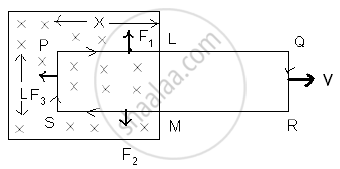
Three forces act on the coil.
F1 on conductor PL ∴ F1 = Bi x, vertically upward.
F2 on conductor MS ∴ F2 = Bi x, vertically downward.
F3 on conductor SP ∴ F3 = Bi L towards left.
F1 and F2 are equal and opposite and also on the same line. They will cancel each other; F3 is a resultant force. The external agent has to do work against this force.
∴ F3 = −Bi l ...(−ve sign indicates that force is opposite to dx.)
If dx is the displacement in time dt, then the work done (dw) = F3 dx.
∴ dw = − BiL dx
This power is an electrical energy ‘ei’ where ‘e’ is an induced e.m.f.
∴ ei = `-(B_i ldx)/(dt)`
∴ e = `-(BLdx)/(dt)`
∴ e = −BLv
∴ e = `-d/dt (BLx)`
∴ e = `(-d phi)/(dt)` ...[from eq (1)]
Lenz’s Law states that the direction of the induced electromotive force (EMF) and the resulting current in a conductor is always such that it opposes the change in magnetic flux that caused it.
Mathematically, Lenz’s Law is expressed as:
ε = `(-d phi_B)/dt`
Where,
ε = Induced EMF
ΦB = Magnetic flux
The negative sign indicates opposition to the change in flux.
Statement:
The direction of the induced emf, or the induced current, in any circuit is such as to oppose the cause that produces it. This law is known as Lenz’s Law.
Explanation / Proof:
- When the north pole of a magnet is moved towards the coil, an induced current flows in the coil in such a direction that the near (left) face of the coil behaves like a north pole.
- Due to the repulsion between the like poles, the motion of the magnet towards the coil is opposed.
- When the north pole of the magnet is moved away from the coil, the induced current flows in such a direction that the near face of the coil becomes a south pole.
- The attraction between opposite poles then opposes the motion of the magnet away from the coil.
In both cases, the induced current opposes the magnet's motion, which is the cause of the current. Therefore, work has to be done to move the magnet, and this mechanical work appears as electrical energy in the coil.
Direction of Induced Current (Fleming’s Right-Hand Rule):
- Stretch the right-hand thumb, forefinger, and middle finger so that they are mutually perpendicular.
- The forefinger points in the direction of the magnetic field.
- The thumb points in the direction of motion of the conductor.
- The middle finger then gives the direction of the induced current.
Conclusion:
Lenz’s Law shows that the induced current always acts in such a direction as to oppose the cause that produces it. This ensures that mechanical energy is converted into electrical energy, and no energy is produced without work being done.
Statement:
When the magnetic flux through a circuit is changing, an induced electromotive force (emf) is set up in the circuit whose magnitude is equal to the negative rate of change of magnetic flux. This is also known as Neumann’s Law.
Mathematical Expression:
If ΔΦB is the change in magnetic flux in a time interval Δt, then the induced emf e is given by:
e = \[-\frac{\Delta\Phi_B}{\Delta t}\]
In the limiting case as Δt → 0:
e = \[-\frac{d\Phi_{B}}{dt}\]
- If dΦB is in weber (Wb) and dtdtdt in seconds (s), then the emf eee will be in volts (V).
- This equation represents an independent experimental law, which cannot be derived from other experimental laws.
For a tightly-wound coil of N turns, the induced emf becomes:
e = \[-N\frac{d\Phi_B}{dt}\] or e = \[-\frac{d(N\Phi_B)}{dt}\]
Here, NΦB is called the ‘number of magnetic flux linkages’ in the coil, and its unit is weber-turns.
Explanation:
Consider a magnet and a coil:
- When the north pole of a magnet is near a coil, a certain number of magnetic flux lines pass through the coil.
- If either the coil or the magnet is moved, the number of magnetic flux lines (i.e., the magnetic flux) through the coil changes.
Cases:
- Magnet moved away from the coil → Decrease in magnetic flux through the coil.
- Magnet brought closer to the coil → Increase in magnetic flux through the coil.
In both cases, an emf is induced in the coil during the motion of the magnet.
- Faster motion → Greater rate of change of flux → Higher induced emf.
- If both the magnet and coil are stationary, or both are moving in the same direction with the same velocity, there is no change in flux → No induced emf.
Special Case:
- If the coil is an open circuit (i.e., infinite resistance), emf is still induced, but no current flows.
- This shows that it is the change in magnetic flux that induces emf, not current.
Conclusion:
Neumann’s Law establishes that a changing magnetic flux through a circuit induces an emf, and the induced emf is proportional to the rate of change of flux, with a negative sign indicating the direction (as per Lenz’s law).
Two circular loops, one of small radius r and the other of larger radius R, such that R >> r, are placed coaxially with centres coinciding. Obtain the mutual inductance of the arrangement.

Let a current IP flow through the circular loop of radius R. The magnetic induction at the centre of the loop is
BP = `(mu_0I_P)/(2R)`
As, r << R, the magnetic induction BP may be considered to be constant over the entire cross-sectional area of the inner loop of radius r. Hence magnetic flux linked with the smaller loop will be
`Φ_S = B_PA_S = (mu_0I_P)/(2R)pir^2`
Also, ΦS = MIP
∴ M = `Phi_S/I_P = (mu_0pir^2)/(2R)`
Statement: The mutual inductance of coil 1 with respect to coil 2 equals the mutual inductance of coil 2 with respect to coil 1.
This is called the Reciprocity Theorem of Mutual Inductance.
Implication: It does not matter which coil drives the current — the mutual inductance M between the pair is always the same property of the system, not just one coil.youtube
Key Points
- Electricity and magnetism are interrelated.
- Electric current can produce a magnetic field.
- A changing magnetic field can produce electric current.
- The production of electric current by a varying magnetic field is called electromagnetic induction.
- Michael Faraday showed in 1831 that a moving magnet can produce current in a conductor.
- The current produced due to electromagnetic induction is called induced current.
- Generators, transformers, induction motors, and wireless chargers work on electromagnetic induction.
- Resistance-box coils are wound with doubled wire.
- Current in adjacent portions flows in opposite directions.
- Magnetic flux linkage remains almost zero.
- This is called non-inductive winding.
- It makes the effect of self-inductance negligible.
- In a Wheatstone bridge, press the cell key before the galvanometer key.
- This prevents confusion caused by momentary galvanometer deflection.
- After taking the reading, release the galvanometer key before the cell key.
Important Questions [9]
- A Coil Has a Self-inductance of 0·05 Henry. Find the Magnitude of the Emf Induced in It When the Current Flowing Through It is Changing at the Rate of 100 As-1.
- When an electric current is passed through a wire or a coil, a magnetic field is produced. Is the reverse phenomenon possible i.e,
- An Emf of 2v is Induced in a Coil When the Current in It is Changed from 0a to 10a in 0·40 Sec. Find the Coefficient of Self-inductance of the Coil.
- A circular coil has radius ‘r', number of turns ‘N’ and carries a current ‘I’. Magnetic flux density ‘B’ at its centre is ______.
- The Figure below shows an infinitely long metallic wire YY' which is carrying a current I'. P is a point at a perpendicular distance r from it.
- Calculate Magnetic Flux Density of the Magnetic Field at the Centre of a Circular Coil of 50 Turns, Having a Radius of 0.5m and Carrying a Current of 5 A.
- Find Magnetic Flux Density at a Point on the Axis of a Long Solenoid Having 5000 Tums/M When It Carrying a Current of 2 A.
- A Rectangular Coil Having 60 Turns and Area of 0.4m2 is Held at Right Angles to a Uniform Magnetic Field of Flux Density 5 × 10⁻⁵t. Calculate the Magnetic Flux Passing Through It.
- A Coil of Self-inductance 2.5h and Resistance 20ω is Connected to a Battery of Emf 120v Having the Internal Resistance of 5 N. Find: 1) The Time Constant of the Circuit. 2) The Current in the Circuit in Steady State
Concepts [16]
- Introduction to Electromagnetic Induction
- Magnetic Flux
- Electromagnetic Induction: Experimental Demonstration
- Faraday's Laws of Electromagnetic Induction
- Induced Current and Induced Charge
- Methods of Changing the Magnetic Flux
- Motion of a Straight Conductor in a Uniform Magnetic Field (Motional EMF)
- Motional Emf: A Conceptual Approach Based on Lenz's Law and Dynamic Flux Analysis
- Motional emf in Rotating a Conducting Rod in a Uniform Magnetic Field
- Self – Induction
- Self-Inductance of a Long Solenoid
- Energy Stored in an Inductor
- Some Examples of the Effect of Self-induced Current
- Mutual Inductance
- Mutual Inductance of Two Long Coaxial Solenoids
- Eddy Currents or Foucault Currents
