Definitions [37]
Light is an electromagnetic wave that travels in straight lines in a homogeneous medium.
-
Speed of light in vacuum: c = 3 × 10⁸ m/s.
For a spherical mirror, the normal at the point of incidence is along the radius, that is, the line joining the centre of curvature of the mirror to the point of incidence, called the normal.
The geometric centre of a spherical mirror is called its pole.
The line joining the pole and the centre of curvature of the spherical mirror is called the principal axis.
The plane perpendicular to the principal axis passing through the principal focus F is called the Focal Plane of the mirror.
The point F on the principal axis where a parallel paraxial beam of light converges (or appears to diverge from) after reflection is called the Principal Focus of the mirror.
The distance between the Principal Focus F and the Pole P of the mirror is called the Focal Length, denoted by f.
f = \[\overline {PF}\]
The distance of the principal focus from the pole is called the focal length (f).
In a spherical mirror, the distance of the object from its pole is called the object distance (u).
The distance of the image from the pole of the mirror is called the image distance (v).
Define the principal focus of a concave mirror.
Light rays that are parallel to the principal axis of a concave mirror converge at a specific point on its principal axis after reflecting from the mirror. This point is known as the principal focus of the concave mirror.
Define the following terms used in the study of reflection of light by drawing a labelled ray-diagram:
- Incident ray
- Point of incidence
- Normal
- Reflected ray
- Angle of incidence
- Angle of reflection
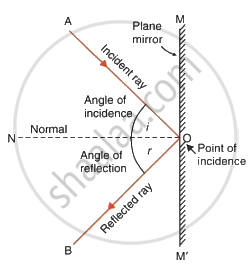
- Incident ray: The ray of light which falls on the mirror surface is called the incident ray.
- Point of incidence: The point at which the incident ray falls on the mirror is called the point of incidence.
- Normal: The normal is a line at right angles to the mirror surface at the point of incidence.
- Reflected ray: The ray of light which is sent back by the mirror is called the reflected ray.
- Angle of incidence: The angle of incidence is the angle made by the incident ray with the normal at the point of incidence.
- Angle of reflection: The angle of reflection is the angle made by the reflected ray with the normal at the point of incidence.
The change in the direction of the path of light when it passes from one transparent medium to another transparent medium is called refraction. The refraction of light is essentially a surface phenomenon.
or
When light passes from one transparent medium to another, its speed and direction change. This is called refraction.
When travelling obliquely from one medium to another, the direction of propagation of light in the second medium changes. This phenomenon is known as refraction of light.
OR
Light changes its direction when going from one transparent medium to another transparent medium. This is called the refraction of light.
OR
The bending of the light ray from its path in passing from one medium to the other medium is called 'refraction' of light.
OR
When a ray of light impinges on a polished, smooth, shiny surface, the rebounding of light within the same medium is called reflection of light.
A normal is an imaginary line drawn perpendicular to the boundary at the point of incidence.
The ray that enters the second medium after crossing the boundary is called the refracted ray.
Refracted light is the part of light enters into the other medium and travels in a straight path but in a direction different from its initial direction and is called the refracted light.
The critical angle is the angle of incidence in the denser medium for which the angle of refraction in the rarer medium is 90 degrees.
Total internal reflection is the complete reflection of light back into an optically denser medium when light travels from a denser medium to a rarer medium and the angle of incidence exceeds the critical angle.
Define critical angle for a given medium.
When a ray of light propagates from a denser medium to a rarer medium, the angle of incidence for which the angle of refraction is 90° is called the critical angle.
The aberration that occurs due to the lens refracting different wavelengths of light at different angles, resulting in an image consisting of different colours without a single focussed image, is called chromatic aberration.
The aberration caused by the spherical shape of the lens, where light rays at the edges focus at a different point than those near the centre, leading to a blurred image, is called spherical aberration.
Define the term ‘focal length of a mirror’.
When rays of light parallel to the principal axis of a mirror are incident on it, the rays after reflection either converge at a point or appear to diverge from a point. The distance of that point from the pole of the mirror is known as the focal length of the mirror.
The point on the principal axis where rays parallel to the principal axis actually meet after refraction, or appear to diverge after refraction, is called the principal focus.
The ratio of the height of the image to the height of the object is called magnification.
The point near the centre of a thin lens through which a ray of light passes without appreciable deviation is called the optical centre.
The distance between the optical centre and the principal focus is called the focal length.
A transparent refracting medium bounded by two surfaces, of which at least one is spherical, is called a lens.
The straight line passing through the optical centre and the centres of curvature of the lens surfaces is called the principal axis.
Angular magnification or magnifying power of an optical instrument is defined as the ratio of the visual angle made by the image formed by that optical instrument (β) to the visual angle subtended by the object when kept at the least distance of distinct vision (α).
For a normal, unaided human eye, D = 25 cm. If an object is brought closer than this, we cannot see it clearly. The minimum distance from the eye at which an object can be seen clearly is called the least distance of distinct vision.
OR
Due to the limitation of focusing the eye lens, it is not possible to take an object closer than a certain distance. This distance is called the least distance of distinct vision.
A simple magnifier or microscope is a converging lens of small focal length.
Define the term ‘resolving power of a telescope’.
The resolving power of an astronomical telescope is defined as the reciprocal of the smallest angular separation between two point objects whose images can just be resolved by the telescope.
R.P = `(1.22 lambda)/D`
Resolving power is the ability of the telescope to distinguish clearly between two points whose angular separation is less than the smallest angle that the observer’s eye can resolve.
An optical instrument that uses objective and eye piece lenses to magnify distant terrestrial or celestial objects is called a telescope.
The SI unit of power of a lens is the dioptre.
One dioptre is the power of a lens whose focal length is 1 metre.
1D = 1m−1
The deviation of the incident light rays produced by a lens on refraction through it, is a measure of its power.
or
The power of a lens is defined as the reciprocal of its focal length. It is represented by the letter P.
OR
The power (P) of a thin lens is equal to the reciprocal of its focal length (f) measured in metres.
Define the power of a lens.
Power of a lens is defined as the ability of a lens to bend the rays of light. It is given by the reciprocal of focal length in metre.
The power of a lens is a measure of the deviation produced by it in the path of rays refracted through it.
Formulae [16]
Magnification (m) = \[\frac{\text{Height of the image (}h'\text{)}}{\text{Height of the object (}h\text{)}}\] = \[\frac {h'}{h}\]
Magnification in terms of object and image distances:
Magnification (m) = \[\frac {h'}{h}\] = -\[\frac {v}{u}\]
\[\frac {1}{v}\] + \[\frac {1}{u}\] = \[\frac {1}{f}\]
For light travelling from medium 1 to medium 2, where medium 1 is denser than medium 2:
where:
- C = critical angle
- n1 = refractive index of the denser medium
- n2 = refractive index of rarer medium
For a denser medium to air:
sin C = \[\frac {1}{μ}\]
where μ is the refractive index of the denser medium with respect to air.
d = t - \[\frac {t}{μ}\] = t\[\left(1-\frac{1}{\mu}\right)\]
n = \[\frac {\text {sin i}}{\text {sin r}}\] = \[\frac {c}{v}\] = \[\frac {\text {Real depth}}{\text {Apparent depth}}\]
For refraction at a spherical surface, the relation is:
\[\frac{n_2}{v}-\frac{n_1}{u}=\frac{n_2-n_1}{R}\]
\[m=\frac{h_i}{h_o}=\frac{v}{u}\]
Where:
- m = magnification.
- hi = height of image.
- ho = height of object.
- v = image distance.
- u = object distance.
\[\frac{1}{v}-\frac{1}{u}=\frac{1}{f}\]
Where:
- u = object distance.
- v = image distance.
- f = focal length of the lens.
\[\frac{1}{f}=(\mu-1)\left(\frac{1}{R_1}-\frac{1}{R_2}\right)\]
Where:
- f = focal length of the lens.
- μ = refractive index of the material of the lens with respect to air.
- R1 = radius of curvature of the first surface.
- R2 = radius of curvature of the second surface.
When the final image is at near point: \[m_e=\left(1+\frac{D}{f_e}\right)\]
When final image is at infinity: \[m_e=\left(\frac{D}{f_e}\right)\]
When the image is formed at infinity, the total magnification is:
m = \[m_om_e=\left(\frac{L}{f_o}\right)\left(\frac{D}{f_e}\right)\]
The linear magnification due to the objective is:
This uses the result:
- \[\mathrm{M_{D.D.V}=\frac{f_{o}}{f_{e}}\left(1+\frac{f_{e}}{D}\right)}\]
- M = \[\frac{\mathrm{f}_{0}}{\mathrm{f}_{0}}\]
\[\frac {1}{v}\] - \[\frac {1}{u}\] = \[\frac {1}{f}\]
Magnification (m) = \[\frac{\text{Height of the Image}}{\text{Height of the object}}=\frac{h^{\prime}}{h}\]
Magnification in terms of object and image distances:
Magnification (m ) = \[\frac {h'}{h}\] = \[\frac {v}{u}\]
Power of lens (in D) = \[\frac{1}{\text{focal length (in metre)}}\]
or
P = \[\frac {1}{f}\]
or
P = \[\frac {1}{f (m)}\]
Power of a Lens in a Medium:
P = (n2 - n1)\[\left(\frac{1}{R_{1}}-\frac{1}{R_{2}}\right)\] = \[\frac {n_1}{f}\]
Theorems and Laws [4]
- The angle of reflection is equal to the angle of incidence.
- The angle of reflection is the angle between the reflected ray and the normal to the reflecting surface or mirror.
- The angle of incidence is the angle between the incident ray and the normal.
- The incident ray, reflected ray, and the normal to the reflecting surface at the point of incidence lie in the same plane.
Important: These laws are valid at each point on any reflecting surface, whether plane or curved.
The laws of refraction are fundamental for board examinations and objective tests.
First law
The incident ray, the refracted ray, and the normal at the point of incidence all lie in the same plane.
Second law
For a given pair of media, the ratio of the sine of the angle of incidence to the sine of the angle of refraction remains constant.
\[\frac {\text {sin i}}{\text {sin r}}\] = constant
This constant is called the refractive index of the second medium with respect to the first medium.
- The angle of reflection is equal to the angle of incidence.
- The incident ray, the reflected ray, and the normal lie in the same plane.
- The incident ray and the reflected ray are on opposite sides of the normal.
-
First Law: Incident ray, refracted ray, and normal to the interface at the point of incidence all lie in the same plane.
-
Second Law (Snell's Law): \[\frac{\sin i}{\sin r}=\mathrm{constant}=\frac{\mu_2}{\mu_1}\]
Extended Snell's Law: \[\frac{\sin i}{\sin r}=\frac{\mu_2}{\mu_1}=_1\mu_2=\frac{v_1}{v_2}=\frac{\lambda_1}{\lambda_2}\]
Key Points
- The laws of reflection apply to both plane and curved reflecting surfaces.
- In spherical mirrors, the normal is taken at the point of incidence.
- The normal is along the radius joining the centre of curvature to the point of incidence.
- The geometric centre of a spherical mirror is called the pole.
- The line joining the pole and the centre of curvature is the principal axis.
| No. | Object Position | Image Position | Nature of Image | Size of Image |
|---|---|---|---|---|
| 1 | At infinity | At focus (F) | Real, Inverted | Highly diminished (point-sized) |
| 2 | Beyond centre of curvature (C) | Between F and C | Real, Inverted | Diminished |
| 3 | At centre of curvature (C) | At centre of curvature (C) | Real, Inverted | Same size as object |
| 4 | Between C and F | Beyond C | Real, Inverted | Enlarged (magnified) |
| 5 | At focus (F) | At infinity | Real, Inverted | Highly enlarged (very large) |
| 6 | Between focus (F) and pole (P) | Behind the mirror | Virtual, Erect | Enlarged (magnified) |
| No. | Object Position | Image Position | Nature of Image | Size of Image |
|---|---|---|---|---|
| 1 | At infinity | At focus (F), behind the mirror | Virtual, Erect | Highly diminished (point-sized) |
| 2 | Between infinity and pole (P) | Between F and P, behind the mirror | Virtual, Erect | Diminished |
- Pole (mirror) or optical centre (lens) is the origin; principal axis is the X-axis.
- Distances to the right are positive, to the left are negative; heights above the axis are positive, below are negative.
- Concave mirror: and R are negative; Convex mirror: and R are positive.
- Real images: image distance and magnification are negative; Virtual images: both are positive.
- Lenses are always negative; they are positive for real images and negative for virtual images; they are positive for convex lenses and negative for concave lenses.
- A lens forms images by refraction at its two spherical surfaces.
- A transparent refracting medium bounded by two surfaces, of which at least one is spherical, is called a lens.
- The new Cartesian sign convention is used in lens problems.
- The focal length of a convex lens is positive, and the focal length of a concave lens is negative.
- The lens formula is: \[\frac {1}{v}−\frac {1}{u}=\frac {1}{f}\]
- The lens maker’s formula is: \[\frac {1}{f}\] = (μ − 1)(\[\frac {1}{R_1}−\frac {1}{R_2}\])
- Magnification is given by: m = \[\frac {h_i}{h_o}\] = \[\frac {v}{u}\]
- A ray through the optical centre passes without appreciable deviation.
- A lens disappears in a liquid if the refractive index of the liquid is the same as that of the lens.
Lens Formula:
\[\frac{1}{v}-\frac{1}{u}=\frac{1}{f}\]
Magnification:
\[m=\frac{h_i}{h_o}=\frac{v}{u}=\frac{f}{f+u}=\frac{f-v}{f}\]
Combination of Thin Lenses in Contact:
- Effective focal length: \[\frac{1}{F}=\frac{1}{f_1}+\frac{1}{f_2}+\frac{1}{f_3}+...\]
- Total power: P = P1 + P2 + P3 + ...
- When one lens is concave and other convex: \[F=\frac{f_1f_2}{f_2-f_1}\]
For Separated Lenses (distance d apart):
Concepts [21]
- Fundamental Concepts of Light
- Reflection of Light by Spherical Mirrors
- Image Formation by Concave Mirror
- Image Formation by a Convex Mirror
- Sign Convention
- Focal Length of Spherical Mirrors
- Ray Optics - Mirror Formula
- Refraction of Light
- Total Internal Reflection
- Refraction at a Spherical Surface and Lenses
- Refraction at a Spherical Surfaces
- Refraction by a Lens
- Thin Lenses and Their Combination
- Refraction of Light through a Prism
- Introduction to Optical Instruments
- Microscope and it’s types
- Telescope
- Law of Reflection of Light
- Laws of Refraction
- Lens Formula
- Power of a Lens
