Marginal Revenue (MR) is the instantaneous rate of change of total revenue with respect to the number of items sold at an instant.
Definitions [23]
Definition: Derivative as a Rate Measure
The derivative \[\frac{dy}{dx}\] represents the rate of change of a variable (y) with respect to another variable (x).
In general, if a quantity depends on another, then its derivative gives the instantaneous rate of change of that quantity.
Definition: Increasing Function
A function f(x) is said to be an increasing function on (a, b) if x₁ < x₂ ⇒ f(x₁) ≤ f(x₂)
Strictly Increasing Function:
- If x₁ < x₂ ⇒ f(x₁) < f(x₂)
Definition: Monotonic Function
A function f is said to be monotonic in an interval if it is either increasing or decreasing in that interval.
Definition: Constant Function
A function f is said to be constant on I if f(x) = c for every x ∈ I, where c is a constant.
Definition: Increasing or Decreasing at a Point
Let x₀ be a point in the domain of a real-valued function f.
The function f is said to be increasing at x₀ if there exists an open interval containing x₀ in which f is increasing.
Similarly, f is said to be decreasing at x₀ if there exists an open interval containing x₀ in which f is decreasing.
Definition: Decreasing Function
A function f(x) is said to be a decreasing function on (a, b) if x₁ < x₂ ⇒ f(x₁) ≥ f(x₂)
Strictly Decreasing Function:
- If x₁ < x₂ ⇒ f(x₁) > f(x₂)
Definition: Maximum and Minimum Values
Let f be a function defined on an interval I.
Maximum value: f has a maximum value at c ∈ I if \[ \boxed{f(c) \geq f(x) \quad \text{for all } x \in I} \]
The value f(c) is called the maximum value and c is called a point of maximum.
Minimum value: f has a minimum value at c ∈ I if \[ \boxed{f(c) \leq f(x) \quad \text{for all } x \in I} \]
The value f(c) is called the minimum value and c is called a point of minimum.
Extreme value: A maximum or minimum value of f is called an extreme value.
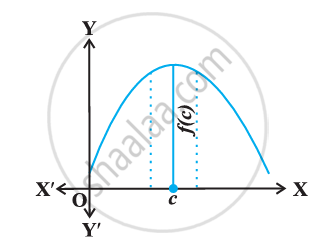
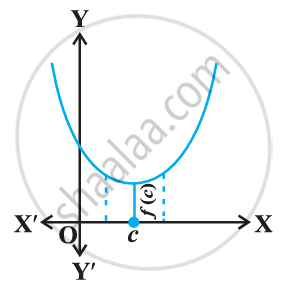
Maximum value Minimum value
Definition: Critical Point
A point in the domain of a function is called a critical point if either the derivative is zero there or the derivative does not exist there. Critical points are checked while locating possible maxima or minima.
Definition: Turning Point
The points where a function changes from decreasing to increasing or from increasing to decreasing are called turning points.
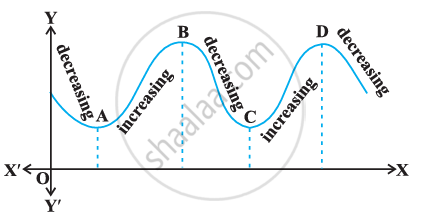
Definition: Turning Point
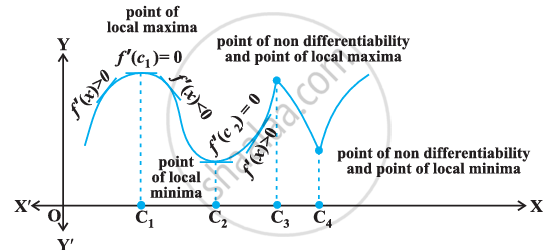
A stationary point x = c (in D) where the function f changes its nature from increasing to decreasing or from decreasing to increasing, i.e. where the function f has local maxima or local minima, is called a turning point.
Definition: Percentage Error
If δx is an error in x, then \[\frac{\delta x}{x}\] × 100 is called the percentage error in x.
Definition: Marginal Cost
Marginal Cost (MC) is the instantaneous rate of change of total cost with respect to the number of items produced at an instant.
Definition: Marginal Revenue
Definition: Minimum Values
f is said to have a minimum value in D if there exists a point x = d in D such that f(d) ≤ f(x) for all x ∈ D. The number f(d) is called the (absolute) minimum value of f in D, and the point d is called the point of minima of f in D.
Definition: Increasing Function
A function f is said to be increasing at a point c if f '(c) > 0.
f is increasing in an interval if
x1 < x2 ⇒ f(x1) ≤ f(x2)
Strictly increasing function:
x1 < x2 ⇒ f(x1) < f(x2)
Definition: Decreasing Function
A function f is said to be decreasing at a point c if f '(c) < 0.
x1 < x2 ⇒ f(x1) ≥ f(x2)
Strictly decreasing function:
x1 < x2 ⇒ f(x1) > f(x2)
Definition: Maximum Values
f is said to have a maximum value in D if there exists a point x = c in D such that f(c) ≥ f(x) for all x ∈ D. The number f(c) is called the (absolute) maximum value of f in D, and the point c is called the point of maxima of f in D.
Definition: Local Maxima
f is said to have a local (or relative) maxima at x = c (in D) if there exists a positive real number δ such that f(c) > f(x) for all x in (c − δ, c + δ) x ≠ c i.e. f(c) > f(x) for all x in the immediate neighbourhood of c, and c is called point of local maxima and f(c) is called local maximum value.
Definition: Local Minima
f is said to have local (or relative) minima at x = d (in D) if there exists some positive real number δ such that f(d) < f(x) for all x ∈ (d − δ, d + δ) x ≠ d i.e. f(d) < f(x) for all x in the immediate neighbourhood of d, and d is called point of local minima and f(d) is called local minimum value.
Definition: Critical Point
A point x = c in the domain of the function f at which either f′(c) = 0 or f is not differentiable i.e. f′(c) does not exist is called a critical point.
Definition: Stationary Point
A point x = c (in D) is called a stationary point iff f is differentiable at x = c and f′(c) = 0.
Definition: Absolute Error
The increment δx in x is called the absolute error in x.
Absolute error in x = |δx|
Definition: Relative Error
If δx is an error in x, then \[\frac{\delta x}{x}\] is called the relative error in x.
Formulae [12]
Formula: Approximations
\[\mathrm{f(a+h)\approx f(a)+h~f^{\prime}(a)}\]
Formula: Rate of Change
\[\text{Rate of change of}y=\frac{dy}{dx}\times\text{rate of change of}x.\]
Formula: Equation of Tangent to the Curve
at P(x1,y1)
\[y-y_1=\left(\frac{dy}{dx}\right)_{x=x_1,y=y_1}(x-x_1)\]
Formula: Differntials
\[\delta y=\frac{dy}{dx}\operatorname{\delta}x\]
Formula: Slope of Normal
\[\text{slope of normal at }P=-\frac{1}{\left(\frac{dy}{dx}\right)_P}\]
Formula: Slope of Tangent
slope of tangent at P = \[\left(\frac{dy}{dx}\right)_P\]
Formula: Angle of Intersection of Two Curves
If m1 and m2 are the slopes of the tangents at the point of intersection, then
\[\tan\theta=\left|\frac{m_1-m_2}{1+m_1m_2}\right|\]
Formula: Instantaneous Rate of Change
\[\lim_{\delta x\to0}\frac{\delta y}{\delta x}=\lim_{x_2\to x_1}\frac{f(x_2)-f(x_1)}{x_2-x_1}\]
Formula: Average Rate of Change
Average rate of change = \[\frac{\delta y}{\delta x}=\frac{f(x_2)-f(x_1)}{x_2-x_1}\]
Formula: Velocity, Acceleration and Jerk
1. Velocity
\[v=\frac{ds}{dt}\]
2. Acceleration
\[a=\frac{dv}{dt}=\frac{d^2s}{dt^2}\]
3. Jerk
\[j=\frac{da}{dt}=\frac{d^3s}{dt^3}\]
Formula: Approximations
\[f(a+h)\approx f(a)+hf^{\prime}(a)\]
Formula: Equation of Normal to the Curve
y = f(x) at P(x1,y1)
\[y-y_1=-\frac{1}{\left(\frac{dy}{dx}\right)_{x=x_1,y=y_1}}(x-x_1)\]
or
\[(x-x_1)+\left(\frac{dy}{dx}\right)_{x=x_1,y=y_1}(y-y_1)=0\]
Theorems and Laws [4]
Rolle’s Theorem
Statement:
If a function f(x):
-
Is continuous on the closed interval [a,b]
-
Is differentiable on the open interval (a,b)
-
Satisfies f(a) = f(b)
Then there exists at least one c∈(a,b)c \in (a,b) such that:
\[f^{\prime}(c)=0\]
Lagrange’s Mean Value Theorem
Statement:
If a function f(x):
-
Is continuous on the closed interval [a,b]
-
Is differentiable on the open interval (a,b)
Then there exists at least one number c ∈ (a,b) such that:
\[f^{\prime}(c)=\frac{f(b)-f(a)}{b-a}\]
Theorem: Second Derivative Test
Assume f'(c) = 0 and the second derivative exists at c:
-
Local Maximum: f''(c) < 0
-
Local Minimum: f''(c) > 0
-
Test Fails: f''(c) = 0. If this happens, you must go back and use the First Derivative Test to check if it is a maxima, minima, or point of inflection.
Theorem: First Derivative Test
Let c be a critical point of a continuous function f:
-
Local Maximum: If f'(x) changes sign from positive to negative as x passes through c, then cc is a point of local maximum.
-
Local Minimum: If f'(x) changes sign from negative to positive then c is a point of local minimum.
-
Point of Inflection: f'(x) does not change sign as x passes through c (it is neither a maxima nor a minima).
Key Points
Key Points: Increasing and Decreasing Functions
- Increasing means output does not decrease as input increases.
- Strictly increasing means output always increases.
- Decreasing means output does not increase as input increases.
- Monotonic means either increasing or decreasing on an interval.
- f′(x) > 0 implies increasing, f′(x) < 0 implies decreasing, and f′(x) = 0 on an interval implies constant behaviour.
- If \[ f'(x) = 0 \] throughout an interval, the function is constant on that interval.
- A single point where \[ f'(x) = 0 \] does not necessarily make the function constant.
- To find intervals of increase or decrease, find the zeros of f'(x), divide the domain into intervals, and check the sign of f'(x).
- A function that is increasing or decreasing on an interval is called monotonic on that interval.
- A function may be increasing on one interval and decreasing on another; in that case it is not monotonic on its entire domain.
Key Points: Maxima and Minima
-
Maxima and minima are extreme values of a function.
-
Critical points occur where \(f'(x)=0\) or \(f'(x)\) is not defined.
-
If \(f'(x)\) changes from positive to negative, the function has a local maximum.
-
If \(f'(x)\) changes from negative to positive, the function has a local minimum.
-
If \(f''(c) < 0\), there is a local maximum at \(x=c\).
-
If \(f''(c) > 0\), there is a local minimum at \(x=c\).
-
For absolute extrema on \([a,b]\), compare values at critical points and endpoints.
-
Not every critical point gives a maximum or minimum.
-
The second derivative test is quick, but the first derivative test is often more reliable in detailed reasoning.
Absolute Maxima/Minima on Closed Interval
-
Step 1: Find critical points in (a, b)
-
Step 2: Take end points a and b
-
Step 3: Find f(x) at all these points
-
Step 4:
Largest value → Absolute maximum
Smallest value → Absolute minimum
Key Point: Second Derivative Test
Let f be twice differentiable at c and f′(c) = 0.
Then:
-
If f′′(c) < 0
→ c is a point of local maxima -
If f′′(c) > 0
→ c is a point of local minima -
If f''(c) = 0
→ Test fails (use first derivative test)
Key Points: First Derivative Test
Let f be continuous at a critical point c.
If:
-
f′(x) changes from positive to negative as x passes through c
→ c is a point of local maxima -
f′(x) changes from negative to positive as x passes through c
→ c is a point of local minima -
f′(x) does not change sign
→ c is neither a maxima nor a minima (point of inflexion)
Key Points: Sign of Function
\[\frac{dy}{dx}\] > 0 → increasing
\[\frac{dy}{dx}\] < 0 → decreasing
\[\frac{dy}{dx}\] = 0 → tangent parallel to x-axis
\[\frac{dy}{dx}\] does not exist → tangent parallel to y-axis
Important Questions [25]
- Find points on the curve given by y = x3 − 6x2 + x + 3, where the tangents are parallel to the line y = x + 5.
- Find the equation of tangent to the curve y = 2x3 – x2 + 2 at (12,2).
- Find the equation of the tangent to the curve at the point on it. y = x2 + 2ex + 2 at (0, 4)
- Find the approximate value of sin (30° 30′). Give that 1° = 0.0175c and cos 30° = 0.866
- The approximate value of tan (44°30'), given that 1° = 0.0175c, is ______.
- Find the approximate value of log10 (1016), given that log10e = 0⋅4343.
- Find the approximate value of tan−1 (1.002). [Given: π = 3.1416]
- Find the approximate value of √8.95
- Find the approximate value of cos (60° 30').
- Verify Lagrange’s mean value theorem for the function f(x) = x+4 on the interval [0, 5].
- Verify Lagrange’s mean value theorem for the following function: f(x) = log x, on [1, e]
- Show that function f(x) = tan x is increasing in π(0,π2).
- The Function F (X) = X^3 – 3x^2 + 3x – 100, X∈ R is
- Show that the function f(x) = x3 + 10x + 7 for x ∈ R is strictly increasing
- Test whether the function is increasing or decreasing. f(x) = x-1x, x ∈ R, x ≠ 0,
- A box with a square base is to have an open top. The surface area of box is 147 sq. cm. What should be its dimensions in order that the volume is largest?
- If 𝑓 ′(𝑥) =𝑘(cos𝑥−sin𝑥),𝑓 ′(0) =3and𝑓(𝜋2) =15, find f(x).
- Find the Approximate Value of Cos (89°, 30').
- An open box is to be made out of a piece of a square card board of sides 18 cms by cutting off equal squares from the comers and turning up the sides. Find the maximum volume of the box.
- A telephone company in a town has 5000 subscribers on its list and collects fixed rent charges of Rs. 3,000 per year from each subscriber.
- A Rod of 108 Meters Long is Bent to Form a Rectangle
- Divide the number 20 into two parts such that sum of their squares is minimum.
- A wire of length 36 metres is bent in the form of a rectangle. Find its dimensions if the area of the rectangle is maximum.
- The maximum value of the function f(x) = logxx is ______.
- Examine the maxima and minima of the function f(x) = 2x^3 - 21x^2 + 36x - 20 . Also, find the maximum and minimum values of f(x).
