English Medium
Academic Year: 2025-2026
Date & Time: 7th March 2026, 10:30 am
Duration: 3h
Advertisements
General Instructions:
Read the following instructions carefully and strictly follow them:
- This question paper contains 38 questions. All questions are compulsory.
- Question paper is divided into FOUR sections - Section A, B, C and D.
Each Section carries 20 marks.- Section A: History
- Section B: Geography
- Section C: Political Science
- Section D: Economics
- This question paper has MCQs, VSAs, SAs, LAs and CBQs.
- Multiple Choice Questions (MCQs) carry 1 mark each.
- Very Short Answer Type Questions (VSAs) carry 2 marks each. Answer to each question should not exceed 40 words.
- Short Answer Type Questions (SAs) carry 3 marks each. Answer to each question should not exceed 60 words.
- Long Answer Type Questions (LAs) carry 5 marks each. Answer to each question should not exceed 120 words.
- There are Cases Based questions (CBQs) with three sub-questions and are of 4 marks each. Answer to each question should not exceed 100 words.
- The map-based questions (two questions) carry five marks-
- Section A - (History) - 2 marks
- Section B - (Geography) - 3 marks
- Divide your answer sheet into four sections as per question paper Section A (History), Section B (Geography), Section C (Political Science),
and Section D (Economics).- It is compulsory to answer each question in its respective section.
- Do not mix answer of one section into the other section.
- Instructions are given with each section and question, wherever necessary.
- Kindly note that a separate question has been provided for visually impaired candidates in lieu of questions having visual inputs, map etc. Such questions are to be attempted by Visually Impaired candidates only.
- There is no overall choice in the question paper. However, an internal choice has been provided in few questions. Only one of the choices in such questions has to be attempted.
Which one of the following pairs is correctly matched?
| Column A (Writer) |
Column B (Contribution) |
| Bal Gangadhar Tilak | Gulamgiri |
| Column A (Writer) |
Column B (Contribution) |
| Jyotiba Phule | Amar Jiban |
| Column A (Writer) |
Column B (Contribution) |
| Raja Rammohan Roy | Sambad Kaumudi |
| Column A (Writer) |
Column B (Contribution) |
| Tarabai Shinde | Istri Dharam Vichar |
Chapter:
Identify this image of the allegorical figure of a European nation during the nineteenth century from the following options:
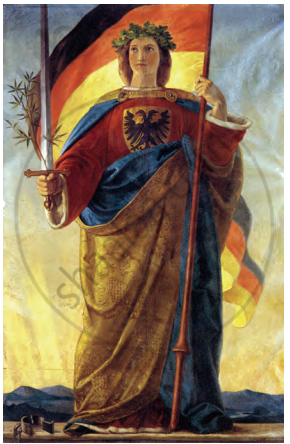
Britannia
Marianna
Helvetia
Germania
Chapter:
Arrange the following events in chronological order and choose the correct option:
- Salt Satyagraha
- Kheda Satyagraha
- Rowlatt Satyagraha
-
Ahmedabad Mill Workers Satyagraha
II, I, III, IV
II, IV, III, I
III, II, IV, I
II, I, IV, III
Chapter:
Assertion (A): The discovery of sea routes to Asia and America shrank the pre-modern world in the sixteenth century.
Reason (R): During this period European entry into Indian ocean expanded trade.
Both (A) and (R) are true and (R) is the correct explanation of (A).
Both (A) and (R) are true, but (R) is not the correct explanation of (A).
(A) is true, but (R) is false.
(A) is false, but (R) is true.
Chapter:
Why did many Europeans migrate to America after sixteenth century? Explain.
Chapter:
Chapter:
“Print culture created the favourable conditions for the French Revolution.” Explain the statement with examples.
Chapter:
“Throughout the nineteenth century, there were a series of innovations in printing technology.” Explain the statement with examples.
Chapter:
Explain the process of formation of 'United Kingdom of Great Britain'.
Chapter:
Explain the process of German Unification during the nineteenth century.
Chapter:
Read the given source carefully and answer the questions that follow:
|
The sense of collective belonging As the national movement developed, nationalist leaders became more and more aware of such icons and symbols in unifying people and inspiring in them a feeling of nationalism. Another means of creating a feeling of nationalism was through reinterpretation of history. By the end of the nineteenth century many Indians began feeling that to instill a sense of pride in the nation, Indian history had to be thought about differently. The British saw Indians as backward and primitive, incapable of governing themselves. In response, Indians began looking into the past to discover India’s great achievements. They wrote about the glorious developments in ancient times when art and architecture, science and mathematics, religion and culture, law and philosophy, crafts and trade had flourished. This glorious time, in their view, was followed by a history of decline, when India was colonised. These nationalist histories urged the readers to take pride in India’s great achievements in the past and struggle to change the miserable conditions of life under British rule.
|
- How did icons help to unite Indians during the freedom struggle? (1)
- Why did nationalists feel the need to rewrite Indian history? (1)
- How did nationalist histories portray India’s past and present? (2)
Chapter:
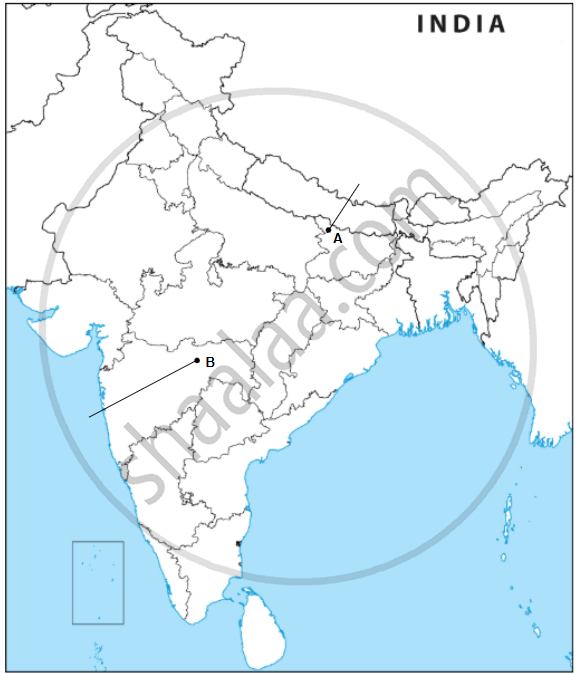
Two places ‘A’ and ‘B’ have been marked on the given political outline map of India. Identify them with the help of the following information and write their correct names on the lines drawn near them.
- The place where Gandhiji launched satyagraha, for the Indigo planters.
- The place where the session of Indian National Congress was held.
Chapter:
Which of the following is an example of ‘current fallow land’?
Land left without cultivation for five agricultural years.
Land left without cultivation for three agricultural years.
Land left without cultivation for two agricultural years.
Chapter:
Choose the appropriate option to fill in the blank:
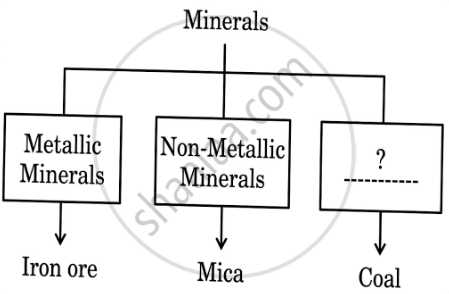
Non-Ferrous minerals
Igneous minerals
Energy minerals
Ferrous minerals
Chapter:
Advertisements
Identify the correct option related to major crops grown in the ‘Kharif’ cropping season in India:
Paddy, Peas, Mustard
Paddy, Mustard, Gram
Paddy, Jowar, Maize
Paddy, Maize, Gram
Chapter:
In which of the following States of India, has the largest area under permanent forests?
Uttar Pradesh
Madhya Pradesh
Gujarat
Maharashtra
Chapter:
Identify the soil with the help of the following informations given in the box and choose the correct option:
|
Alluvial Soil
Black Soil
Laterite Soil
Chapter:
Match Column-I with Column-II and choose the correct option:
| Column - I (National Parks) |
Column - II (States) |
| a. Sariska | i. Madhya Pradesh |
| b. Sunderban | ii. Uttarakhand |
| c. Corbett | iii. West Bengal |
| d. Bandhavgarh | iv. Rajasthan |
a - iii, b - ii, c - i, d - iv
a - iv, b - ii, c - iii, d - i
a - iv, b - iii, c - ii, d - i
a - ii, b - iv, c - iii, d - i
Chapter:
Explain the measures made by government to improve Indian agriculture.
Chapter:
Explain the difference between conventional and non-conventional sources of energy.
Chapter:
Read the given source carefully and answer the questions that follow:
|
Pradhan Mantri Krishi Sinchayee Yojana Floods have not only devastated life and property but also caused extensive soil erosion. Sedimentation also meant that the flood plains were deprived of silt, a natural fertilizer, further adding on to the problem of land degradation. It was also observed that the multipurpose projects induced earthquakes, caused water-borne diseases and pests and pollution resulting from excessive use of water. Irrigation has also changed the cropping pattern of many regions with farmers shifting to water intensive and commercial crops. This has great ecological consequences like salinisation of the soil. Pradhan Mantri Krishi Sinchayee Yojana has been started which ensures access to some means to protective irrigation for all agricultural farms in the country, thus bringing much desired rural prosperity. Some of the broad objectives of this programme are to enhance the physical access of water on the farm and expand cultivable area under assured irrigation (har khet ko pani), improve on farm water, use efficiency to reduce wastage and increase availability both in duration and extent, irrigation and other water saving technologies (per drop more crop) and introduce sustainable water conservation practices, etc. |
- Explain the role of floods in land degradation. (1)
- How has irrigation changed cropping pattern? (1)
- Explain any two objectives of the ‘Pradhan Mantri Krishi Sinchayee Yojana’. (2)
Chapter:
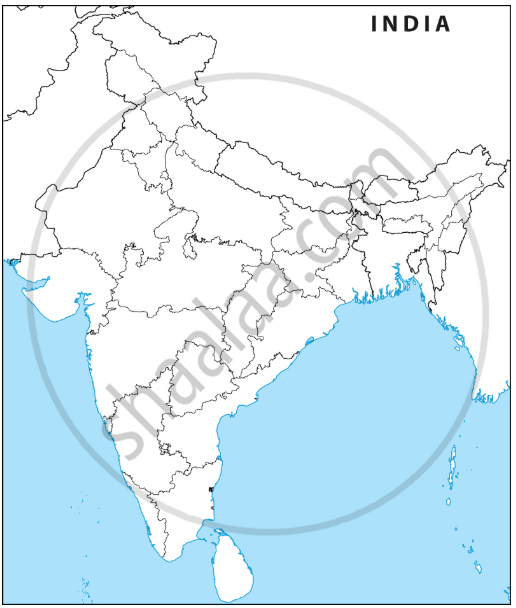
On the given outline map of India, locate and label any three of the following with suitable symbols:
- The dam constructed on Satluj river (1)
- A nuclear power plant located in Gujarat (1)
- A software technology park located in Uttar Pradesh (1)
- An International Airport located in Maharashtra (1)
Chapter:
Read the given statements regarding urban local government and choose the correct option:
- Municipalities are setup in towns.
- Big cities have Municipal Corporation.
- Municipal chairperson is the head of Block Samiti.
-
The officer in Municipal Corporation is called as Mayor.
Only I, II and III are correct.
Only I, II and IV are correct.
Only I, III and IV are correct.
Only II, III and IV are correct.
Chapter:
Find the odd one out regarding the Political Parties of India:
Bharatiya Janata Party & Aam Aadmi Party
Indian National Lok Dal & Jananayak Janata Party
National’s People’s Party & United Democratic Party
Rashtriya Janata Dal & Loktantrik Samajwadi Party
Chapter:
Look at the given cartoon carefully and answer the question that follow:
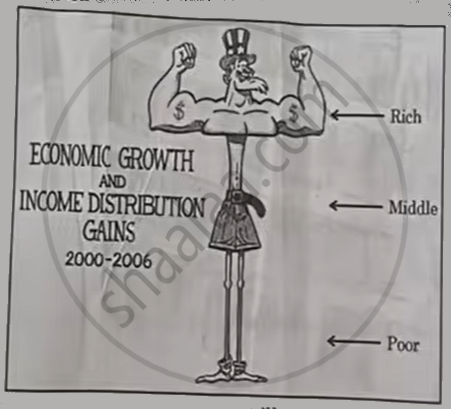
Which of the following concepts is best illustrated in the cartoon?
Inclusive economic growth amongst nations
Stagnation of economic development amongst nations
Uneven distribution of wealth amongst nations
Balanced economic growth amongst nations
Chapter:
Assertion (A): Belgium’s power sharing arrangements were designed to accommodate its linguistic and cultural divisions.
Reason (R): Belgian leaders recognized the existence of regional differences and cultural diversities.
Both (A) and (R) are true and (R) is the correct explanation of (A).
Both (A) and (R) are true, but (R) is not the correct explanation of (A).
(A) is true, but (R) is false.
(A) is false, but (R) is true.
Chapter:
Suggest any two ways to promote women in various professional fields.
Chapter:
Advertisements
"Democracy is better than any other alternative government." Justify the statement.
Chapter: [3.5] Outcomes of Democracy
How does the ‘system of three lists’ function in Indian federalism? Explain with examples.
Chapter:
Analyse the role of political parties in ensuring good governance.
Chapter:
Analyse the need of Political Parties in India.
Chapter:
Read the given source carefully and answer the questions that follow:
|
Forms of Power-sharing The idea of power-sharing has emerged in opposition to the notions of undivided political power. For a long time, it was believed that all power of a government must reside in one person or group of persons located at one place. It was felt that if the power to decide is dispersed, it would not be possible to take quick decisions and to enforce them. But these notions have changed with the emergence of democracy. One basic principle of democracy is that people are the source of all political power. In a democracy, people rule themselves through institutions of self-government. In a good democratic government, due respect is given to diverse groups and views that exist in a society. Everyone has a voice in the shaping of public policies. Therefore, it follows that in a democracy, political power should be distributed among as many citizens as possible. |
- How does power sharing promote stability of political order? (1)
- How are pressure groups part of the power sharing mechanism? (1)
- How does power sharing contribute to the spirit of democracy? (2)
Chapter:
Identify the sector of economy with the help of information given in the box:
|
Private Sector
Public Sector
Joint Sector
Cooperative Sector
Chapter:
Study the given data and answer the question that follow:
| Comparative Data of few States | |||
| Infant Mortality Rate (2020) |
Literacy Rate (2017-18) |
Net Attendance Rate (Class 1 to 5) |
|
| State A | 28 | 82 | 73 |
| State B | 6 | 94 | 94 |
| State C | 27 | 62 | 69 |
By how many of the following points does State B’s literacy rate exceeds from State A in 2017-18?
12
10
16
14
Chapter:
Which of the following is the main purpose of a trade barrier in global trade? Choose the correct option.
To promote the growth of foreign companies in a country
To control the production of domestic industries
To regulate foreign trade into the country
To stop foreign trade between countries
Chapter:
Read the following case and choose the correct option:
|
Megha has taken a loan of ₹ 5 lakhs from bank to purchase a house. The annual rate on the loan is 12% and loan is to be repaid in 5 years in monthly instalments.
|
Collateral
Cost of Credit
Duration of Loan
Documentation
Chapter:
Which of the following is an example of a renewable resource?
Natural Gas
Crude Oil
Coal
Ground Water
Chapter:
Infant Mortality Rate indicates the number of children that die before the age of ______ year(s) per 1000 live births in that particular year.
One
Two
Three
Four
Chapter:
'Improvement in technology has stimulated the globalisation process.' Explain the statement with examples.
Chapter:
Explain any three terms of Credit.
Chapter: [4.3] Money and Credit
“Different persons can have different developmental goals.” Support the statement with an example.
Chapter: [4.1] Development
Explain the efforts done by the Indian government towards “Right to work”.
Chapter:
Differentiate between organised and unorganised sectors.
Chapter:
Other Solutions
Submit Question Paper
Help us maintain new question papers on Shaalaa.com, so we can continue to help studentsonly jpg, png and pdf files
CBSE previous year question papers Class 10 Social Science with solutions 2025 - 2026
Previous year Question paper for CBSE Class 10 Social Science-2026 is solved by experts. Solved question papers gives you the chance to check yourself after your mock test.
By referring the question paper Solutions for Social Science, you can scale your preparation level and work on your weak areas. It will also help the candidates in developing the time-management skills. Practice makes perfect, and there is no better way to practice than to attempt previous year question paper solutions of CBSE Class 10.
How CBSE Class 10 Question Paper solutions Help Students ?
• Question paper solutions for Social Science will helps students to prepare for exam.
• Question paper with answer will boost students confidence in exam time and also give you an idea About the important questions and topics to be prepared for the board exam.
• For finding solution of question papers no need to refer so multiple sources like textbook or guides.
