Commerce (English Medium)
Science (English Medium)
Arts (English Medium)
Academic Year: 2024-2025
Date & Time: 1st April 2025, 10:30 am
Duration: 3h
Advertisements
General Instructions:
Read the following instructions carefully and follow them:
- This question paper contains 34 questions. All questions are compulsory.
- Question paper is divided into five Sections – Section A, B, C, D and E.
- Section A – question numbers 1 to 21 are Multiple Choice type Questions. Each question carries 1 mark.
- Section B – question numbers 22 to 27 are Short Answer type Questions. Each question carries 3 marks. Write an answer to each question in 60 to 80 words.
- Section C – question numbers 28 to 30 are Long Answer (LA) type Questions. Each question carries 8 marks. Write an answer to each question in 300 to 350 words.
- Section D – question numbers 31 to 33 are Source-based Questions having three sub-questions. Each question carries 4 marks.
- Section E – question number 34 is Map Based Question that includes the identification and location of significant test items. This question carries 5 marks. Attach the Map with the answer-book.
- There is no overall choice. However, an internal choice has been provided in Sections B and C of the question paper. A candidate has to write an answer for only one of the alternatives in such questions.
- In addition to this, NOTE that a separate question has been provided for Visually Impaired Candidates in lieu of questions having visual inputs, Map etc. Such questions are to be attempted by Visually Impaired Candidates only.
Match Column-I with Column-II and choose the correct option from the following:
| Column-I (Ancient Mahajanpadas) |
Column-II (Present Region) |
| a. Magadh | I. Qandhar (Eastern Afghanistan) |
| b. Avanti | II. Ayodhya (Uttar Pradesh) |
| c. Gandhara | III. Patna (Bihar) |
| d. Koshala | IV. Ujjain (Madhya Pradesh) |
a − III, b − II, c − I, d − IV.
a − IV, b − II, c − I, d − III.
a − III, b − IV, c − I, d − II.
a − II, b − I, c − III, d − IV.
Chapter:
Consider the following statements regarding Jainism and choose the correct option:
- The cycle of birth and rebirth is shaped through Karma.
- There is a need to renounce the world.
- Worldly existence is a necessary condition for attaining salvation.
- The principle of Ahimsa is important.
I, II, and III
II, III, and IV
I, II, and IV
I, III, and IV
Chapter:
Assertion (A): Buddhism grew rapidly both during the lifetime and after the death of Buddha.
Reason (R): Many people were dissatisfied with existing religious practices and confused by the rapid social changes taking place around them.
Both (A) and (R) are true, and (R) is the correct reasoning of (A).
Both (A) and (R) are true, but (R) is not the correct reasoning of (A).
(A) is true, (R) is untrue.
(A) is untrue, (R) is true.
Chapter:
Prabhavati Gupta is best known for which of the following roles?
Wife of Ashoka and Promoter of Buddhist Sangha
Queen of the Mauryan Empire and Promoter of Buddhism
Wife of Samudragupta and Poet of the Gupta Era
Daughter of Chandragupta-II and Wife of Vakataka King
Chapter:
Which of the following is correct regarding the Harappan script?
This script was alphabetical.
It was written from left to right.
This script has not been deciphered so far.
This script has a few signs or symbols.
Chapter:
In which of the following sites of the Harappan civilization the terracotta models of plough have been discovered?
Kalibangan and Dholavira
Shortughai and Lothal
Banawali and Cholistan
Sanghol and Rakhigarhi
Chapter:
The following picture shows the structure of a temple carved out of a single piece of rock. Identify this temple correctly from the given options:
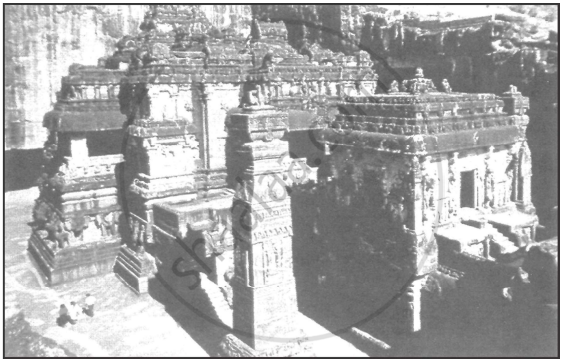
Deogarh Temple
Kailashnatha Temple
Mahabalipuram Temple
Brihideshwara Temple
Chapter:
Which of the following statements regarding Colonel Colin Mackenzie are correct? Choose the correct option:
- The ruins of Hampi were brought to light in 1800 by him.
- He was an official of the East India Company.
- He prepared the first survey maps of the site.
- He received information about the Vijayanagara empire from Duarte Barbosa.
I, II, and III
II, III, and IV
I, III, and IV
I, II, and IV
Chapter:
Match Column-I with Column-II and choose the correct option from the following:
| Column-I (Foreign Travellers) |
Column-II (Countries) |
| a. Afanasi Nikitin | I. Persia |
| b. Domingo Paes | II. Russia |
| c. Abdur-Razzak | III. Portugal |
| d. Nicolo de Conti | IV. Italy |
a − III, b − IV, c − I, d − II
a − II, b − III, c − I, d − IV
a − I, b − II, c − IV, d − III
a − II, b − I, c − III, d − IV
Chapter:
In a modern city, a group of friends discusses the relevance of Kabir’s teachings in today’s society. Some believe these are outdated, while others see their significance in promoting equality and love. Which of the following scenarios best reflects Kabir’s relevance today?
A debate on Kabir’s historical context.
A discussion dismissing spirituality as irrelevant.
Focus on societal norms and traditions only.
Seeking a simple connection with the divine.
Chapter:
Which one of the following statements is most appropriate regarding the zamindars of 16th and 17th-century India?
The zamindars were the exploitative class for the peasants.
The zamindars collected revenue on behalf of the state.
They always maintained cordial relations with the villagers.
The zamindars had a small piece of land for personal use.
Chapter:
Which of the following is a major source to understand the agrarian history of the 16th and 17th centuries in India?
Revenue records of Agra & Delhi
Relationship between peasants and zamindars
Important chronicle – the Ain-e-Akbari
Types of agricultural crops grown at that time
Chapter:
Al-Biruni’s major work, ‘Kitab-ul-Hind’, is significant for its comprehensive study of India. Which of the following was the primary aim of this work?
Promote Islamic teaching
Map geographical locations
Critique culture and traditions
Document Indian culture
Chapter:
Advertisements
Throughout his extensive travels, Ibn Batuta was able to explore unfamiliar cultures and societies. Which of the following competencies did he most likely develop?
Leadership and Judicial Management
Cultural Competencies and Skills
Knowledge of Administration and the Army
Scientific and Technical expertise
Chapter:
Match the Column-I with Column-II and choose the correct option:
| Column-I (Leadership of the Revolt of 1857) |
Column-II (Regions) |
| a. Shah Mal | I. Lucknow |
| b. Kunwar Singh | II. Kanpur |
| c. Birjis Qadr | III. Baraut |
| d. Nana Sahib | IV. Arrah |
a − II, b − III, c − IV, d − I.
a − III, b − IV, c − I, d − II.
a − III, b − II, c − I, d − IV.
a − IV, b − II, c − III, d − I.
Chapter:
Which one of the following was the main cause of the Santhal Rebellion of 1855?
Imposition of the Summary Settlement
Cultural suppression by the British
Imposition of Western education
Heavy taxes and land annexation
Chapter:
Which one of the following was a key feature of the ‘Subsidiary Alliance’ introduced by Lord Wellesley in 1798?
The Free Trade Policy was brought by the British.
Maintenance of the native army by the British.
Imposition of Western Customs by the British.
Protection of the native territory by the British.
Chapter:
Arrange the following historical events in a correct chronological order and choose the correct option:
- Making of the Constituent Assembly
- Jallianwala Bagh Massacre
- Quit India Movement
- Gandhi-Irwin Pact
II, III, I, and IV
II, IV, III, and I
III, II, I, and IV
IV, III, I, and II
Chapter:
Identify the member of the Constituent Assembly with the help of the following information:
|
Sarvepalli Radhakrishnan
Zakir Hussain
V. V. Giri
Rajendra Prasad
Chapter:
Which one of the following pairs is correctly matched?
| List-I (Name of Important Committees of Constituent Assembly) |
List-II (Name of President) |
|
| Flag Committee | – | H.C. Mookerjee |
| List-I (Name of Important Committees of Constituent Assembly) |
List-II (Name of President) |
|
| Union Power Committee | – | Pandit Jawaharlal Nehru |
| List-I (Name of Important Committees of Constituent Assembly) |
List-II (Name of President) |
|
| Rules of Procedure Committee | – | S. Varadachariar |
| List-I (Name of Important Committees of Constituent Assembly) |
List-II (Name of President) |
|
| States Committee | – | J.B. Kripalani |
Chapter:
Find the odd one out regarding the Permanent Settlement of 1793.
The Sunset law
The Burdwan’s Auction
The Fifth Report
The Deccan Riots Commission
Chapter:
“Ashokan inscriptions are the most significant sources to understand the administration of Ashoka.” Explain the statement.
Chapter:
“The history of the Mauryan Empire has been constructed on a variety of sources.” Explain the statement.
Chapter:
“Art historians had to acquire familiarity with Hagiographies of Buddha in order to understand Buddhist sculpture.” Explain the statement in the context of Sanchi Stuра.
Chapter:
Analyse the causes that led to the ruin of the Vijayanagara Empire.
Chapter:
Analyse why the Amaranayaka system was considered a major political innovation of the Vijayanagara empire.
Chapter:
Advertisements
Examine the role of the Panchayat in advocating for the rights of common people during the Mughal era.
Chapter:
Examine how art and literature have helped in keeping the memories of 1857 alive.
Chapter:
Describe the views of Gandhiji on the national language of India.
Chapter:
“There were specific features of the familial relationship during the Mahabharata period.” Explain the statement with examples.
Chapter:
“The political power or kingship was rarely dependent on birth as Kshatriyas, but also open to anyone who could muster support and resources.” Explain the statement with examples from the sixth century BCE onwards.
Chapter:
Explain the beliefs and teachings of Alvars and Nayanars during the Medieval India.
Chapter:
“The Salt March was the movement that brought Gandhiji to the world's attention.” Analyse the statement.
Chapter:
“As a consequence of the Non-Cooperation Movement, the British Raj was shaken to its foundation, for the first time since the revolt of 1857.” Analyse the statement.
Chapter:
Read the following source carefully and answer the questions that follow:
|
A warning for Europe Bernier warned that if European kings followed the Mughal model: Their kingdoms would be very far from being well-cultivated and peopled, so well built, so rich, so polite and flourishing as we see them. Our kings are otherwise rich and powerful, and we must avow that they are much better and more royally served. They would soon be kings of deserts and solitudes, of beggars and barbarians, such as those whom I have been representing. (the Mughals) .... We should find the great Cities and the great Burroughs (boroughs) rendered uninhabitable because of ill air, and to fall to ruine (ruin) without anybodies (anybody) taking care of repairing them; the hillocks abandon’d, and the fields overspread with bushes, or fill’d with pestilential marishes (marshes), as hath been already intimated. |
- Mention any one prominent contribution of Bernier. (1)
- How did Bernier describe the difference between the European kingdom and the Mughal territories? (1)
- Explain Bernier’s views on the socio-economic status of people under Mughal rule. (2)
Chapter:
Read the following source carefully and answer the questions that follow:
|
On clearance and settled cultivation Passing through one village in the lower Rajmahal hills, Buchanan wrote: The view of the country is exceedingly fine, the cultivation, especially the narrow valleys of rice winding in all directions, the cleared lands with scattered trees, and the rocky hills are in perfection; all that is wanted is some appearance of progress in the area and a vastly extended and improved cultivation, of which the country is highly susceptible. Plantations of Asan and Palas, for Tessar (Tassar silk worms) and Lac, should occupy the place of woods to as great an extent as the demand will admit; the remainder might be all cleared and the greater part cultivated, while what is not fit for the purpose might rear Plamira (palmyra) and Mowa (mahua). |
- How did Buchanan describe the view of the lower Rajmahal hills? (1)
- Why did Buchanan believe that the area had high potential for improved cultivation? (1)
- How did Buchanan propose utilising the land for economic benefits? (2)
Chapter:
Read the following source carefully and answer the questions that follow:
|
The most ancient system yet discovered About the drains, Mackay noted: “It is certainly the most complete ancient system as yet discovered.” Every house was connected to the street drains. The main channels were made of bricks set in mortar and were covered with loose bricks that could be removed for cleaning. In some cases, limestone was used for the covers. House drains first emptied into a sump or cesspit, where solid matter settled, while waste water flowed out into the street drains. Very long drainage channels were provided at intervals, with sumps for cleaning. It is a wonder of archaeology that “little heaps of material, mostly sand, have frequently been found lying alongside drainage channels, which shows... that the debris was not always carted away when the drain was cleared”. From Ernest Mackay, Early Indus Civilisation, 1948. Drainage systems were not unique to the larger cities, but were found in smaller settlements as well. At Lothal, for example, while houses were built of mud bricks, drains were made of burnt bricks. |
- Analyse the possible reasons behind the uniformity in the drainage systems across the Harappan cities. (1)
- Analyse the implications of finding little heaps of material, mostly sand, alongside drainage channels. (1)
- Assess the impact of the Harappan drainage system. (2)
Chapter:
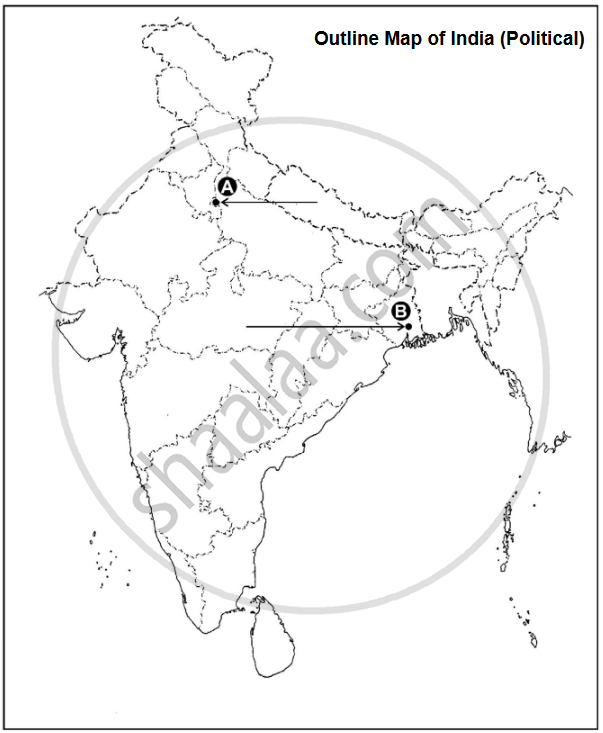
1. On the given political outline map of India, locate and label the following with appropriate symbols:
- Kalibanga − a mature Harappan site
- Amravati − a Buddhist site
-
- Amber – a territory under the Mughals
OR - Bijapur – An important town of Medieval India
- Amber – a territory under the Mughals
2. On the same outline map, two places have been marked A and B as the centres of the 1857 revolt. Identify them and write their names on the lines drawn near them.
Chapter:
Other Solutions
Submit Question Paper
Help us maintain new question papers on Shaalaa.com, so we can continue to help studentsonly jpg, png and pdf files
CBSE previous year question papers Class 12 History with solutions 2024 - 2025
Previous year Question paper for CBSE Class 12 History-2025 is solved by experts. Solved question papers gives you the chance to check yourself after your mock test.
By referring the question paper Solutions for History, you can scale your preparation level and work on your weak areas. It will also help the candidates in developing the time-management skills. Practice makes perfect, and there is no better way to practice than to attempt previous year question paper solutions of CBSE Class 12.
How CBSE Class 12 Question Paper solutions Help Students ?
• Question paper solutions for History will helps students to prepare for exam.
• Question paper with answer will boost students confidence in exam time and also give you an idea About the important questions and topics to be prepared for the board exam.
• For finding solution of question papers no need to refer so multiple sources like textbook or guides.
