Advertisements
Advertisements
प्रश्न
Your friend can read a book perfectly well but cannot read the writing on blackboard unless she sits on the front row in class.
Is she short-sighted or long-sighted?
Advertisements
उत्तर
She is short-sighted.
APPEARS IN
संबंधित प्रश्न
Given below is a diagram showing a defect of human eye. Study it and answer the following questions.

(i) Name the defect shown in the figure.
(ii) Give reason for this defect of eye in human being.
(iii) Name the type of lens used to correct the eye defect.
What is myopia?
the biological/technical terms for the lens of eye losing flexibility resulting in a kind of long-sightedness in middle aged people.
Name the defect of vision which makes the eye-lens cloudy resulting in blurred vision.
What are the two most common defects of vision (or defects of eye)? How are they corrected?
Name the defect of vision which can be corrected by a converging lens. Show clearly by a ray diagram how the lens corrects the defect.
Explain with the help of labelled ray-diagram, the defect of vision called hypermetropia, and hot it is corrected by a lens.
A person suffering from the eye-defect myopia (short-sightedness) can see clearly only up to a distance of 2 metres. What is the nature and power of lens required to rectify this defect?
An eye has a near point distance of 0.75 m. What sort of lens in spectacles would be needed to reduce the near point distance to 0.25 m? Also calculate the power of lens required. Is this eye long-sighted or short-sighted?
Which part of the eye is grafted in a needy patient from a donated eye?
State the main functions of the following:
Tears
Select the odd one in the following series:
Endolymph, Tympanic membrane, Semi-circular canal, Blind spot.
Give Reason:
When you enter into a dark room from bright because of sunlight, you can not see things for a few seconds.
Give Technical Term:
The path which responsible for protecting the eye from sweat.
Give Technical Term:
The type of lens used to correct myopia is
Given below is a diagrammatic representation of a defect of the human eye:

(i) Identify the defect.
(ii) Mention two reasons for the above defect.
(iii) State how the defect can be rectified.
(iv) Name the part of the eye responsible for maintaining the shape of the eyeball.
Mention, if the following statement is True or False
Hypermetropia is a defect of the eye caused due to the eyeball elongation
Observe the given below the figure, correct it and explain and write about the concept depicted in this figure.
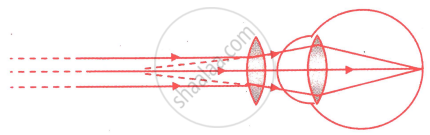
A person cannot see distinctly objects kept beyond 2 m. This defect can be corrected by using a lens of power:
Given alongside is a diagram depicting a defect of the human eye. Study the same and answer the questions that follow:
 |
- Name the defect shown in the diagram.
- Give two possible reasons for this defect.
- Name the parts labelled 1 to 4.
- Name the type of lens used to correct this eye defect.
- Draw a labelled diagram to show how the above mentioned defect is rectified using the lens named above.
