Advertisements
Advertisements
प्रश्न
Write the first four members of the homologous series that begins with H-C≡C-H. Also, write down their general molecular formula.
Advertisements
उत्तर
| No. | Name of a compound and molecular formula | Structural formula |
| 1. | Ethyne (C2H2) | HC ≡ CH |
| 2. | Propyne (C3H4) | CH3 - C ≡ CH |
| 3. | But-1-yne (C4H6) | CH3 - CH2 - C ≡ CH |
| 4. | Pent-1-yne (C5H8) | CH3 - CH2 - CH2 - C ≡ CH |
Comparing these molecular formulae and assigning the number of carbon atoms as ‘n’, the following general formula is deduced: CnH2n - 2 (where n = 2, 3, 4...)
APPEARS IN
संबंधित प्रश्न
Draw a formula for the first five members of the homologous series beginning with the given compound.
H–COOH
Draw a formula for the first five members of the homologous series beginning with the given compound.
CH3COCH3
Draw a formula for the first five members of the homologous series beginning with the given compound.
H–CH=CH2
Identify the functional group in the following compound.
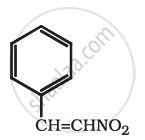
Identify primary, secondary, tertiary and quaternary carbon in the following compound.

Give the general characteristics of organic compounds.
Describe the classification of organic compounds based on their structure.
Write the molecular formula of the first six members of homologous series of nitro – alkanes.
The reagent used to confirm the presence of five hydroxyl groups in glucose is ____________.
Identify the pair of organic compounds which belongs to homologous series.
An organic compound containing carbon, hydrogen and oxygen is soluble in dil. H2SO4 and does not react with sodium metal or KMnO4. When it is heated with HI in excess, a single alkyl halide is obtained. The original compound can be ____________.
Which of the following statements is INCORRECT for the organic compounds which belong to homologous series?
What is the molecular formula of pyran?
Identify the number of carbon atoms and number of oxygen atoms respectively present in furan molecule.
An organic compound 'X' (molecular formula C6H7O2N) has six carbons in a ring system, two double bonds and also a nitro group as a substituent, 'X' is ______.

A and B are:
A pyranose ring consists of a skeleton of ______.
Identify primary, secondary, tertiary and quaternary carbon in the following compounds.
\[\begin{array}{cc}
\ce{CH3}\phantom{.................}\\
|\phantom{...................}\\
\ce{CH3 - C - CH - CH2 - CH2 - CH3}\\
\phantom{}|\phantom{....}|\phantom{...............}\\
\phantom{}\ce{CH3}\phantom{.}\ce{CH3}\phantom{.............}
\end{array}\]
Identify primary, secondary, tertiary, and quaternary carbon in the following compounds.
\[\begin{array}{cc}
\ce{CH3}\phantom{..................}\\
|\phantom{....................}\\
\ce{CH3 - C - CH - CH2 - CH2 - CH3}\\
\phantom{}|\phantom{....}|\phantom{................}\\
\phantom{.}\ce{CH3\phantom{.}CH3}\phantom{..............}
\end{array}\]
Identify the α - carbons in the following species and give the total number of
\[\ce{CH3 -CH2 -\overset{⊕}{C}H -CH2 -CH3}\]
Identify primary, secondary, tertiary and quaternary carbon in the following compounds.
\[\begin{array}{cc}
\ce{CH3}\phantom{.................}\\
|\phantom{....................}\\
\ce{CH3 - C - CH - CH2 - CH2 - CH3}\\
|\phantom{....}|\phantom{................}\\
\ce{CH3}\ce{CH3}\phantom{..............}
\end{array}\]
Identify primary, secondary, tertiary and quaternary carbon in the following compound.
\[\begin{array}{cc}
\ce{CH3}\phantom{..................}\\
|\phantom{....................}\\
\ce{CH3 - C - CH - CH2 - CH2 - CH3}\\
|\phantom{....}|\phantom{................}\\
\ce{CH3}\phantom{..}\ce{CH3}\phantom{..............}\\
\end{array}\]
Identify primary, secondary, tertiary and quaternary carbon in the following compound.
\begin{array}{cc}
\ce{CH3}\phantom{..................}\\
|\phantom{....................}\\
\ce{CH3 - C - CH - CH2 - CH2 - CH3}\\
|\phantom{....}|\phantom{................}\\
\ce{CH3}\ce{CH3}\phantom{..............}
\end{array}
Indicate the σ and π bonds in the following molecule:
\[\ce{HCONHCH3}\]
Identify primary, secondary, tertiary and quaternary carbon in the following compound:
\[\begin{array}{cc}
\ce{CH3}\phantom{.................}\\
|\phantom{....................}\\
\ce{CH3 - C - CH - CH2 - CH2 - CH3}\\
|\phantom{....}|\phantom{................}\\
\ce{CH3}\phantom{.}\ce{CH3}\phantom{..............}\\
\end{array}\]
Identify primary, secondary, tertiary and quaternary carbon in the following compound.
\[\begin{array}{cc}
\ce{CH3}\phantom{.................}\\
|\phantom{....................}\\
\ce{CH3 - C - CH - CH2 - CH2 - CH3}\\
|\phantom{.....}|\phantom{................}\\
\ce{CH3}\phantom{.}\ce{CH3}\phantom{..............}
\end{array}\]
Identify primary, secondary, tertiary and quaternary carbon in the following compound.
\[\begin{array}{cc}
\ce{CH3}\phantom{.................}\\
|\phantom{....................}\\
\ce{CH3 - C - CH - CH2 - CH2 - CH3}\\
|\phantom{....}|\phantom{................}\\
\ce{CH3}\phantom{.}\ce{CH3}\phantom{..............}
\end{array}\]
Which of the following is neopentyl chloride?
