Advertisements
Advertisements
प्रश्न
Write a relationship between the angle of incidence and angle of refractions for a given pair of media
Advertisements
उत्तर
The ratio of the sine of the angle of incidence to the sine of the angle of refraction is constant for a given pair of media called the refractive index
`(sin i)/(sin r) = mu`
APPEARS IN
संबंधित प्रश्न
Name one factor that affects the lateral displacement of light as it passes through a rectangular glass slab.
When a ray of light from air enters a denser medium, it ______.
How does the angle of minimum deviation produces by a prism change with increase in :
the refracting angle of prism?
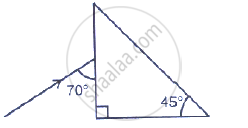
Complete Fig. 4.32 to show the path of the ray of single colour as it enters the prism and emerges out of it. Mark the angles wherever necessary.
Which of the following has the highest refractive index:
Draw an í- `delta` graph for a mono chromatic raY through a glass prism of a plane and mark
(i) `delta` m, the angle of mínimum devíation
(íí) Any two values of i for which value of `delta` ís same.
A ray of light strikes the surface at a rectangular glass slab such that the angle of incidence is 45o.
In each case, draw diagram to show the path taken by the ray as it passes through the glass slab and emerges from it.
How does the angle of deviation produced by a prism depend on the colour of light used? Which colour of white light is deviated (i) most, (ii) least, by a prism?
How does the angle of deviation produced by a prism depend on the angle of incidence of light at the prism surface? Draw a graph to illustrate your answer.
