Advertisements
Advertisements
प्रश्न
Write the electronic configuration of K and Ne.
Advertisements
उत्तर
| Element | Electronic configuration |
| K | 2,8,8,1 |
| Ne | 2,8 |
APPEARS IN
संबंधित प्रश्न
Taking the example of an element of atomic number 16, explain how the electronic configuration of the atom of an element relates to its position in the modern periodic table and how valency of an element is calculated on the basis of its atomic number.
Calcium is an element with atomic number 20. Stating reason, answer each of the following questions:-
(i) Is calcium a metal or a non-metal?
(ii) Will its atomic radius be larger or smaller than that of potassium with atomic number 19?
(iii) Write the formula of its oxide.
Name the element that has two shells, both of which are completely filled with electrons.
Which element has the electronic configuration 2, 8, 2?
Rewrite the following statement after correction, if necessary:
Elements in the same period have equal valency
Rewrite the following statement after correction, if necessary:
The metallic character of elements in a period increases gradually on moving from left to right.
Why do elements in the same group show similar properties but the elements in different groups show different properties?
How does the tendency to gain electrons change as we go down in group 17 of the periodic table? Why does it change this way?
Explain why, the properties of elements are repeated after 2, 8, 18 and 32 elements in the periodic table.
In terms of electronic configurations, explain the variation in the size of the atoms of the elements belonging to the same period and same group ?
In each of the following pair, choose the atom having the bigger size:
Na (At. No. 11) or K (At. No. 19)
Periodicity is observed due to the similar ______.
What do you understand by periodicity?
An element A has atomic number 14. To which period does this element belong and how many elements are there in this period.
An element X belong to 4th period and 17th group, state.
no of valence electrons in it
Why fluorine has higher E.N. than chorine?
Which element has:
twice as many electrons in its second shell as in its first shell?
Name the element in period 3 which does not form oxide.
Name the element of lower nuclear charge out of Be and Mg.
Chorine in the periodic table is surrounded by the elements with atomic number 9, 16, 18 and 35.
Which is more electronegative than chlorine?
Four elements P, Q, R and S belong to the third period of the Modern Periodic Table and have respectively 1, 3, 5 and 7 electrons in their outermost shells. Write the electronic configurations of Q and R and determine their valences. Write the molecular formula of the compound formed when P and S combine.
Study the extract of the Periodic Table given below and answer the questions that follow. Give the alphabet corresponding to the element in question. DO NOT repeat an element. 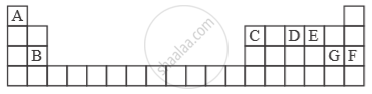
Which is an inert gas?
Fill in the blank
There are ______ groups and ______ periods in the modern form of periodic table.
State whether the following statement is true or false
Similar electronic configuration is repeated after intervals of 2, 8, 8, 18 and 32.
Select the correct answer
Most reactive character among the elements given below is found in
What is meant by a group in the periodic table?
Arrange the following as per instruction given in the bracket.
Cl, F, Br, I (increasing electron affinity)
Arrange the following as per instruction given in the bracket.
Cs, Na, Li, K, Rb (decreasing electronegativity)
The elements of one short period of the periodic table are given below in order from left to right:
| Li | Be | B | C | O | F | Ne |
Which one of the above elements belongs to the halogen series?
The position of elements A, B, C, D and E in the periodic table are shown below:
|
Group 1 |
Group 2 |
Group 17 |
Group 18 |
|
|
|
|
D |
|
|
B |
C |
|
|
A |
|
|
E |
State which is metals, non-metals, and noble gas in this table.
An element A has 2 electrons in its fourth shell. State:
its valency
What is the common feature of the electronic configuration of the elements at the end of Period 2 and Period 3?
What is meant by a Group in the Periodic Table?
Name or state following with reference to the elements of the first three periods of the periodic table.
The number of electron shells in elements of period 1, period 2, and period 3.
Select the correct answer from the options given below.
It is a metal in period 2 having electronic configuration 2, 1?
State the following:
The group to which the element with an electronic configuration of 2, 8, 2 belongs.
Complete the table pertaining to the following elements given in Column I.
| Column I Elements | Atomic Number | Electronic Configuration | Underline the element present in that group |
| 1. Hydrogen | 1 | ______ | Be/Na/Ca |
| 2. Carbon | 6 | ______, ______ | N/P/Si |
| 3. Nitrogen | 7 | _______, ______ | C/P/S |
| 4. Oxygen | 8 | _______, ______ | N/S/Cl |
| 5. Sulphur | 16 | _____, ______, _______ | O/N/F |
| 6. Chlorine | 17 | _____, ______, ______ | I/O/S |
