Advertisements
Advertisements
प्रश्न
Working in pair, decide which of the following items in italics is definite (or specific) and which is indefinite (or non-specific).
Then complete the following sentence using appropriate articles.
- 1950 is ___ year in which India became a republic.
Advertisements
उत्तर
- 1950 is the year in which India became a republic.
Definite (specific)
APPEARS IN
संबंधित प्रश्न
In this unit you will use the words which help to identify things – to say whether they are known or unknown to the listener, which one(s) the speaker is talking about, whether the speaker is thinking of specific examples or talking in general. You will also work with words which say ‘how much’ or ‘how many’.
There are twenty determiners in the grid given below. Encircle these determiners.
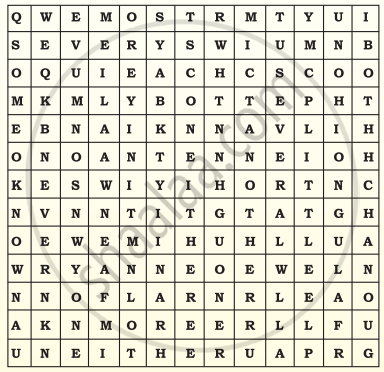
Working in pair, decide which of the following items in italics is definite (or specific) and which is indefinite (or non-specific).
Then complete the following sentence using appropriate articles.
- Australia, ................ country in the southern Hemisphere, has produced some world-class sportspersons.
Working in pair, decide which of the following items in italics is definite (or specific) and which is indefinite (or non-specific).
Then complete the following sentence using appropriate articles.
- ___ fruit seller does not earn much during the rainy season.
Working in pair, decide which of the following items in italics is definite (or specific) and which is indefinite (or non-specific).
Then complete the following sentence using appropriate articles.
- The Amazon is considered to be ___ largest river in the world, in terms of volume of water.
Working in pair, decide which of the following items in italics is definite (or specific) and which is indefinite (or non-specific).
Then complete the following sentence using appropriate articles.
- .............. Punjab, .......... important state of North India, has five rivers flowing through it.
In groups of four, read the following description from a geography book, and underline the geographical names.
The Himalayas, the highest mountain range in the world, protect India from the cold winds blowing from central Asia and the People's Republic of China. Mount Everest, the highest mountain peak of the world belongs to this range and is situated in Nepal. To the south of the Himalayas, the great northern plains extend between the mouth of the rivers Indus and the Ganga. The Indus, the Ganga and the Brahmaputra start in the Himalayas .The Indus starts in Tibet near Mansarovar Lake. The Ganga rises in the Himalayas and the Brahmaputra, also known as Tsang Po, starts in Tibet. The Ganga and the Brahmaputrajoin together before flowing into the Bay of Bengal. Between the fertile Indus and Ganga plains are the Aravalli Hills and the Thar Desert.
Now discuss within your groups how the article is used (or not used) before geographical terms, and complete the following table:
| Names | Category | Use of the | Conclusion | Other examples |
| Himalyas | Mountain range | The' is used before names of mountain ranges |
The Alps The Andes |
|
| Mount Everest | ||||
| Cities | Pune, Delhi | |||
| India Nepal |
||||
|
People's Republic of China |
A country whose name includes words like republic, union etc. | |||
| Rivers | ||||
| Dal lake | ||||
| Deserts |
You and your friend have been asked to help the quiz-master to prepare questions for a geography quiz in your school. You may choose topics from the list below to prepare your questions:
| continents oceans and seas countries deserts mountains lakes rivers and canals |
Work in pairs. Each pair should write at least five questions (and their
answers), e.g.
| What do you cross, when travelling from Europe to the USA? (The Atlantic Ocean) |
You may use an atlas. Remember what you have learned in B.4 about using
or not using the.
..............................................................
.................................................................
When you have written your questions, your teacher wW organize a class
quiz.
The following paragraph has not been edited. (There is one error or omission in each line). The errors have been underlined and the omissions marked with a '/'. Write your corrections in the space provided. The first correction has been done as an example.
The area of/ Atlantic Ocean south of Florida the
has been an tricky one for travellers. --------
In the days of sail, ships crossing / area ---------
often found themselves becalmed for/ periods. ---------
To save drinking water, more horses on board ----------
would be thrown into / sea. ----------
Nevertheless, any sailors died of thirst. -----------
One of/ unique sea-going mysteries ever, -----------
an 103-foot sailing ship was found floating, -----------
abandoned with the life-boat missing. -----------
In the last 100 years much than 50 ships ------------
and 20 aeroplanes have disappeared in the Bermuda triangle. ------------
Choose the appropriate option from the box to complete the given sentence.
l had left _____I [ the/ my] green shirt on the bed, but l can't find it now.
Choose the appropriate option from the box to complete the given sentence.
Is there ____1 [ the/ a ] fitness centre near your house ?

Given below is a picture of a beautiful scene you saw on your trip to Varanasi, Uttar Pradesh. Write an email to your friend Harsh, in Bangalore, describing the scene. To help you write your e-mail, firs match the determiners in the box with items from the picture. (X indicates that the word does not require a determiner.) Apart from the determiners given in the box, you can also use other suitable determiners.
two, three (etc), an, a, the, several, many, very little, every, each, X
.......... mango groves
............. ghats
............. riverganga
...............prayer flags
.............. ascetics
............ boats
............. tourists
............ temples
............. devotees
............ team of security officials
.............. sand
Choose the appropriate option from the box to complete the given sentence.
________[ one/ few/ an ] example helps understand concepts better.
Choose the appropriate option from the box to complete the given sentence.
That house at the comer of the street belongs to _____ [ many / those ] people who are standing near its gate.
Choose the appropriate option from the box to complete the given sentence.
He drove with ______Care [ much / little ] care and hence was fined by the Traffic Police .
Choose the appropriate option from the box to complete the given sentences.
_________[ any / each ]student of this class is a scholar badge holder.
Choose the appropriate option from the box to complete the given sentence.
The ______[ many / three ] monkeys that escaped from the Delhi zoo were found eating bananas in a fruit shop.
From the following sentence, underline the Nouns and encircle their Determiners that specify the nouns in a noun phrase.
(articles/possessive pronouns/demonstratives or quantifiers)
Over the years, Hawking has written 15 books.
From the following sentence, underline the Nouns and encircle their Determiners that specify the nouns in a noun phrase.
(articles/possessive pronouns/demonstratives or quantifiers)
A few events prevented him from despondency.
