Advertisements
Advertisements
प्रश्न
With the help of suitable diagrams, explain the five stages of prophase-I of meiosis.
Advertisements
उत्तर
Prophase-I is the first stage of meiosis-I and is the longest and most important stage. It is divided into five sub-stages:
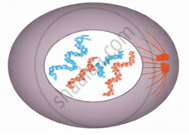
1. Leptotene
- Chromosomes begin to condense.
- They become long, thin, and distinct.
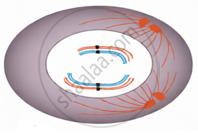
2. Zygotene
- Homologous chromosomes pair together by a process called synapsis.
- A synaptonemal complex is formed.
- Paired chromosomes form bivalents or tetrads.
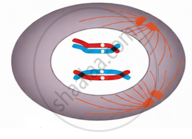
3. Pachytene
- It is the longest stage of Prophase-I.
- Chromosomes become shorter and thicker.
- Crossing over occurs between non-sister chromatids of homologous chromosomes.
- Recombination nodules appear at crossing-over sites
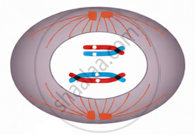
4. Diplotene
- Synaptonemal complex dissolves.
- Homologous chromosomes begin to separate.
- Chiasmata appear at crossover points.
5. Diakinesis
- Chiasmata terminalise.
- Chromosomes condense further.
- The nuclear membrane and nucleolus disappear.
- Meiotic spindle fibres begin to form.
APPEARS IN
संबंधित प्रश्न
The diagram below represents a stage during cell division. Study the same and then answer the questions that follow:

- Name the parts labelled 1, 2, and 3.
- Identify the above stage and give a reason to support your answer.
- Mention where in the body this type of cell division occurs.
- Name the stage prior to this stage and draw a diagram to represent the same.
Describe anaphase in mitosis.
Define the following:
Karyokinesis
Fill in the blank:
______ takes place in body cells resulting in growth and development.
In which one of the following options the two stages of mitosis have been given in correct sequence?
Identify the stages of mitosis given below and label the figures.
The figure below shows a certain stage of mitosis:
(i) Name the stage,
(ii) Label the parts 1 to 4
(iii) How many chromosomes are shown here?
Draw a labeled schematic representation of mitosis cell division.
Name the following:
Replacement of dead cells is accomplished by which process.
Name the Following
Nuclear envelope and nucleoli reappear in which stage.
The karyotype (set of chromosomes) shown below is taken from a dividing cell in a certain individual.
(i) Is the individual male or female? Explain your answer.
(ii) How would you expect
(a) a female cell and
(b) sperm cell to differ in chromosome composition?
Give the sequence of the events occurring during the prophase of mitosis.
Identify the stage of mitosis from the below picture. List the chromosomal events in this stage.
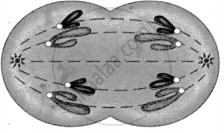
During Mitosis what is the position of chromatids in metaphase?
Name these:
Two steps of the process Mitosis
