Advertisements
Advertisements
प्रश्न
Name the following:
Replacement of dead cells is accomplished by which process.
Advertisements
उत्तर
Mitosis
संबंधित प्रश्न
The diagram given below represents a certain stage of mitosis:
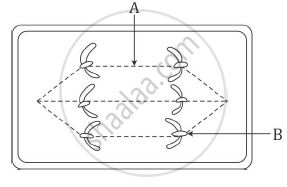
- Identify the stage of cell division.
- Name the parts labelled A and B.
- What is the unique feature observed in this stage?
- How many daughter cells are formed from this type of cell division?
The diagram given below represents a stage during cell division.
Study the same and answer the questions that follow:

- Identify whether it is a plant cell or an animal cell. Give a reason in support of your answer.
- Name the stage depicted in the diagram. What is the unique feature observed in this stage?
- Name the type of cell division that occurs during:
- Replacement of old leaves by new ones
- Formation of gametes
- What is the stage that comes before the stage shown in the diagram?
- Draw a neat, labelled diagram of the stage mentioned in (iv) above keeping the chromosome number constant.
Define the following:
Karyokinesis
Fill in the blank:
______ is the indirect cell division.
In which one of the following options the two stages of mitosis have been given in correct sequence?
Explain the Term Pachytene
Complete the following sentence with appropriate word :
Colchicine arrests cell division at __________.
Multiple Choice Question:
Karyokinesis is the division of
Column ‘II’ is a list of items related to ideas in Column ‘I’. Match the terms in Column ‘II’ with a suitable idea given in Column ‘I’.
| Column I | Column II |
| (i) Anaphase | (a) Chromosomes become arranged in a horizontal plane at the equator. |
| (ii) Prophase | (b) Daughter chromosomes move to opposite poles of the spindle. |
| (iii) Telophase | (c) Chromosomes become visible as fine, long threads. |
| (iv) Metaphase | (d) Chromosomes lose their distinctiveness and gradually become transformed into chromatin network. |
The karyotype (set of chromosomes) shown below is taken from a dividing cell in a certain individual.
(i) Is the individual male or female? Explain your answer.
(ii) How would you expect
(a) a female cell and
(b) sperm cell to differ in chromosome composition?
During Mitosis what is the position of chromatids in metaphase?
During Mitosis what is the position of chromatids in the anaphase?
The phase of karyokinesis which is almost the reverse of prophase is ______.
Match List - I with List - II.
| List - I | List - II |
| A. Centromere | I. Mitochondrion |
| B. Cilium | II. Cell division |
| C. Cristae | III. Сell movement |
| D. Cell membrane | IV. Phospholipid Bilayer |
Choose the correct answer from the options given below:
