Advertisements
Advertisements
प्रश्न
The karyotype (set of chromosomes) shown below is taken from a dividing cell in a certain individual.
(i) Is the individual male or female? Explain your answer.
(ii) How would you expect
(a) a female cell and
(b) sperm cell to differ in chromosome composition?
Advertisements
उत्तर
(i) Male, because there is a Y-chromosome and an X-chromosome.
(ii)
(a) A female would have two X-chromosomes and no Y-chromosome.
(b) A sperm cell would have half the number of chromosomes. 23 instead of 46. There would be only one sex-chromosome which could be either Y or X.
संबंधित प्रश्न
The diagram given below represents a certain stage of mitosis:
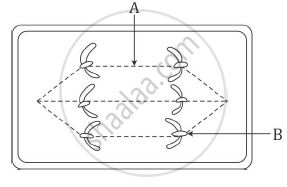
- Identify the stage of cell division.
- Name the parts labelled A and B.
- What is the unique feature observed in this stage?
- How many daughter cells are formed from this type of cell division?
For formation of plasma membrane, ______ molecules are necessary.
Define the following:
Karyokinesis
Fill in the blank:
______ is the indirect cell division.
Choose the correct answer:
Which division takes most time?
The diagram below represents a certain stage of a cell.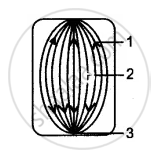
(i) Is it an animal cell or a plant cell ? Give one reason in support of your answer.
(ii) Label the parts numbered 1 – 3.
(iii) Which stage (phase) of mitosis is represented in this diagram
Draw a labeled schematic representation of mitosis cell division.
Name the following:
Replacement of dead cells is accomplished by which process.
Complete the following sentence with appropriate word :
______means the splitting of the nucleus.
Mention, if the following statement is True or False. If false rewrite the wrong statement in its correct form:
The alkaloid colchicine inhibits the formation of the mitotic spindle.
Multiple Choice Question:
Karyokinesis is the division of
Give the sequence of the events occurring during the prophase of mitosis.
During Mitosis what is the position of chromatids in metaphase?
Name these:
Two steps of the process Mitosis
Match List - I with List - II.
| List - I | List - II |
| A. Centromere | I. Mitochondrion |
| B. Cilium | II. Cell division |
| C. Cristae | III. Сell movement |
| D. Cell membrane | IV. Phospholipid Bilayer |
Choose the correct answer from the options given below:
