Advertisements
Advertisements
प्रश्न
The fig given alongside shows a certain stage in a cell division in a cell with four chromosomes.
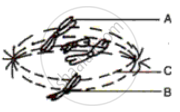
(i) Name the parts of the chromosome labeled A and B.
(ii) Name the structure C. what is its function?
(iii) Name the type of division . Give a reason.
(iv) Name the stage of division.
(v) Name the stages before and after the stage shown in diagram.
Advertisements
उत्तर
(i) A - Duplicated chromosomes
B - Centromere
(ii) The structure C is Spindle fibre. Its function is to help in the movement of chromosomes.
(iii) The type of cell division is mitosis because all chromosomes appear to be same as there is no crossing over.
(iv) Metaphase.
(v) Prophase occurs before metaphase and after metaphase anaphase takes place.
APPEARS IN
संबंधित प्रश्न
Genetic recombination occurs in ______ phase of prophase of meiosis-I.
Describe anaphase in mitosis.
Define the following:
Karyokinesis
Fill in the blank:
______ takes place in body cells resulting in growth and development.
Fill in the blank:
______ is the indirect cell division.
Choose the correct answer:
Nuclear membrane reappears in ____________
Draw a well-labelled diagram to show the anaphase stage of mitosis in plant cells having four chromosomes.
Explain the Term Pachytene
Name the following:
Mitosis takes place in which cells.
Name the following:
Replacement of dead cells is accomplished by which process.
Name the Following
The stage when chromosomes arrange at the equator.
Name the Following
Nuclear envelope and nucleoli reappear in which stage.
Give Technical Terms
Division of nucleus.
Mention, if the following statement is True or False. If false rewrite the wrong statement in its correct form:
The alkaloid colchicine inhibits the formation of the mitotic spindle.
Choose the Odd One Out
Multiple Choice Question:
The nuclear membrane and nucleolus become indistinguishable during
Write the functional activity of the following structure:
Colchicine
The karyotype (set of chromosomes) shown below is taken from a dividing cell in a certain individual.
(i) Is the individual male or female? Explain your answer.
(ii) How would you expect
(a) a female cell and
(b) sperm cell to differ in chromosome composition?
