Advertisements
Advertisements
प्रश्न
Why is the core of a transformer laminated?
Advertisements
उत्तर
The core of a transformer is laminated to reduce the energy loss due to eddy currents.
APPEARS IN
संबंधित प्रश्न
On which type of current do transformers work?
You are required to make an electromagnet from a soft iron bar by using a cell, an insulated coil of copper wire and a switch. (a) Draw a circuit diagram to represent the process. (b) label the poles of the electromagnet.
The adjacent diagram shows a coil would around a soft iron bar XY. (a) State the polarity at the end X and Y as the switch is pressed. (b) Suggest one way increasing the strength of electromagnet so formed.
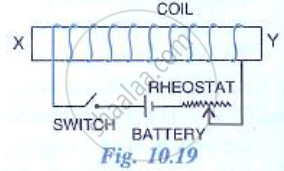
State two ways through which the strength of an electromagnet can be increased.
Name the phenomenon ?
What is the function of a transformer in an a.c. circuit? How do the input and output powers in a transformer compare?
A transformer is designed to work from a 240 V a.c. mains and to give a supply of 8 V to ring a house bell. The primary coil has 4800 turns. How many turns will be in the secondary coil?
State the underlying principle of a transformer. How is the large scale transmission of electric energy over long distances done with the use of transformers?
A transformer lowers e.m.f. from 220 V to 15 V. If the number of turns in primary are 3520, how many turns are in the secondary coil?
Transformer works on ______.
In a transformer, the number of turns in the primary and the secondary are 410 and 1230 respectively. If the current in primary is 6A, then that in the secondary coil is
A step-down transformer reduces the supply voltage from 220 V to 11 V and increase the current from 6 A to 100 A. Then its efficiency is
Explain the working of the transformer.
Which among the following, is not a cause for power loss in a transformer?
A transformer is essentially an a.c. device. It cannot work on d.c. It changes alternating voltages or currents. It does not affect the frequency of a.c. It is based on the phenomenon of mutual induction. A transformer essentially consists of two coils of insulated copper wire having different numbers of turns and wound on the same soft iron core.
The number of turns in the primary and secondary coils of an ideal transformer is 2000 and 50 respectively. The primary coil is connected to a main supply of 120 V and secondary coil is connected to a bulb of resistance 0.6 Ω.
Power in primary coil is ______.
A transformer operating at primary voltage 8 kV and secondary voltage 160 V serves a load of 80 kW. Assuming the transformer to be ideal with purely resistive load and working on unity power factor, the loads in the primary and secondary circuit would be:
Mention two main sources of power loss in real transformers.
For what purpose are the transformers used?
A 12 V, 60 W lamp is connected to 220 V AC via an ideal transformer. Find the primary current.
