Advertisements
Advertisements
प्रश्न
Why did Abbu Khan feel sad?
Advertisements
उत्तर
Abbu Khan fed his goats on the juiciest grass and grains. He showered deep love on them as one shower on one’s children. Still, they broke the ropes loose and ran straight into the jaws of death. It made Abbu Khan feel sad. Even the animals preferred death to slavery (bondage).
संबंधित प्रश्न
Match the meanings with the words/expressions in italic, and write the appropriate
meaning next to the sentence.
I knew a man was following me, I was scared out of my wits.
Thinking about Poem
What is the meaning of “bleeding bark”? What makes it bleed?
He flungs himself down in a corner to recoup from the fatigue of his visit to the shop. His wife said, “You are getting no sauce today, nor anything else. I can’t find anything to give you to eat. Fast till the evening, it’ll do you good. Take the goats and be gone now,” she cried and added, “Don’t come back before the sun is down.”
Read the extract given below and answer the question that follow.
Where had Muni gone and why?
So after that, dimly, dimly, she sensed it, she was different and they knew her difference and kept away. There was talk that her father and mother were taking her back to Earth next year; it seemed vital to her that they do so, though it would mean the loss of thousands of dollars to her family. And so, the children hated her for all these reasons of big and little consequence. They hated her pale snow face, her waiting silence, her thinness, and her possible future. “Get away 1” The boy gave her another push. “What’re you waiting for?”Then, for the first time, she turned and looked at him. And what she was waiting for was in her eyes. “Well, don’t wait around here !” cried the boy savagely. “You won’t see nothing!” Her lips moved. “Nothing 1” he cried. “It was all a joke, wasn’t it?” He turned to the other children. “Nothing’s happening today. Is it ?”
Read the extract given below and answer the question that follow.
What was the rumour? What did Margot think?
The music master is making lovely music. Read aloud the sentence in the text that expresses this idea.
Why did the neighbours kill the dog?
The beggar was leaning against what in Ravi’s garden?
What did the narrator’s grandfather see at the zoo?
Who oiled the motor?
Why and when did Dad say the following?
Never mind
What does a garden snake eat?
Answer the following question. (Refer to that part of the text whose number is given against the question. This applies to the comprehension questions throughout the book.)
Why did the little man grant Patrick a wish? (2)
Use the clues given below to complete this crossword puzzle.
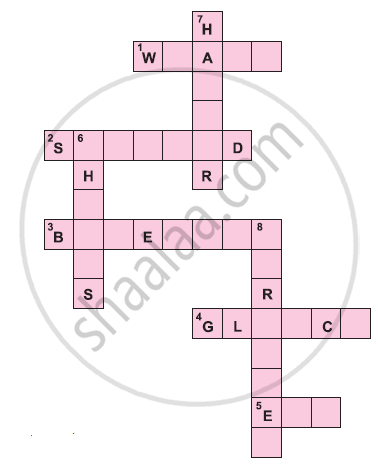
Across
1. very tired
2. had an angry look on the face
3. short trousers
4. a fault in a machine that prevents it from working properly
5. a small and naughty boy-fairy
Down
6. work that must be done every day, often boring
7. a basket with a lid
8. gave a short, high-pitched cry
Answer the following question:
When and why did she go to the U.S.? Who did she marry?
What did the speaker do while hiding himself in the banyan tree branches?
What are some of the particular habits of the mongoose and the camel?
According to the speaker’s brother, where did the ghost hid himself?
Put each of the following in the correct order. Then use them appropriately to fill in the blanks in the paragraph that follows. Use correct punctuation marks.
- English and Hindi/both/in/he writes
- and only / a few short stories/many books in English/in Hindi
- Is/my Hindi / than my English/much better
Ravi Kant is a writer and ………….. Of course, he is much happier writing in English than in Hindi. He has written …………….. . I find his books a little hard to understand ………………… .
Choose the option that lists the sequence of events in the correct order.
- When the rain stopped, they rushed outdoors, forgetting all about Margot in their eagerness to experience the warmth of the sun.
- The children carried the pleading and protesting Margot to the closet and locked her in.
- It was then that they realised with shame that Margot was still locked in the closet; they had deprived her of what she longed for the most-the sun.
- All too soon, the brief summer ended, and the children hurried indoors to escape the heavy rains.
