Advertisements
Advertisements
प्रश्न
Answer these question in 30–40 words.
Why did Bismillah Khan refuse to start a shehnai school in the U.S.A.?
Advertisements
उत्तर
Bismillah Khan refused one of his student’s request to start a shehnai school in the U.S.A. because he would not live away from Hindustan, specifically, from Benaras, the River Ganga and Dumraon.
संबंधित प्रश्न
Can you think of any scientists, who have also been statesmen?
“A slumber did my spirit seal,” says the poet. That is, a deep sleep ‘closed off’ his soul (or mind). How does the poet react to his loved one’s death? Does he feel bitter grief? Or does he feel a great peace?
Subject Verb Agreement.
A verb must be in the same number and person as its subject e.g.
(a) A man and his wife have lived here since January 2009.
(b) Arun, a great scholar, is dead.
(c) Either James or Peter is to be promoted.
( d) The horse as well as its rider was hurt by the fall.
(e) Not only India, but also the whole world recognises Gandhiji's
achievements
(f) Eachman was rewarded.
(g) Every tree has been saved.
(h) The Adventures of Tom Jones is a great novel.
Of the seven hundred villages dotting the map of India, in which the majority of India’s five hundred million live, flourish and die, Kritam was probably the tiniest, indicated on the district survey map by a microscopic dot, the map being meant more for the revenue official out to collect tax than for the guidance of the motorist, who in any case could not hope to reach it since it sprawled far from the highway at the end of a rough track furrowed up by the iron-hooped wheels of bullock carts. But its size did not prevent its giving itself the grandiose name Kritam, which meant in Tamil coronet or crown on the brow of the subcontinent. The village consisted of fewer than thirty houses, only one of them built from brick and cement and painted a brilliant yellow and blue all over with
gorgeous carvings of gods and gargoyles on its balustrade, it was known as the Big House. The other houses, distributed in four streets, were generally of bamboo thatch, straw, mud and other unspecified material. Muni’s was the last house in the fourth street, beyond which stretched the fields. In his prosperous days Muni had owned a flock of sheep and goats and sallied forth every morning driving the flock to the highway a couple of miles away.
Read the extract given below and answer the question that follow.
What did the Big House look like?
The horse was nearly life-size, moulded out of clay, baked, burnt, and brightly coloured, and reared its head proudly, prancing its forelegs in the air and flourishing its tail in a loop; beside the horse stood a warrior with scythelike mustachios, bulging eyes, and aquiline nose. The old image-makers believed in indicating a man of strength by bulging out his eyes and sharpening his moustache tips, and also decorated the man’s chest with beads which looked today like blobs of mud through the ravages of sun and wind and rain (when it came), but Muni would insist that he had known the beads to sparkle like the nine gems at one time in his life.
Read the extract given below and answer the question that follow.
Describe the horse.
Lights were shining from every window, and there was a savoury smell of roast goose, for it was New-year’s eve—yes, she remembered that. In a corner, between two houses, one of which projected beyond the other, she sank down and huddled herself together. She had drawn her little feet under her, but she could not keep off the cold; and
she dared not go home, for she had sold no matches, and could not take home even a penny of money. Her father would certainly beat her; besides, it was almost as cold at home as here, for they had only the roof to cover them, through which the wind howled, although the largest holes had been stopped up with straw and rags. Her little hands were almost frozen with the cold. Ah! perhaps a burning match might be some good, if she could draw it from the bundle and strike it against the wall, just to warm her fingers. She drew one out—“scratch!” how it sputtered as it burnt! It gave a warm, bright light, like a little candle, as she held her hand over it. It was really a wonderful light. It seemed to the little girl that she was sitting by a large iron stove, with polished brass feet and a brass ornament. How the fire burned! and seemed so beautifully warm that the child stretched out her feet as if to warm them, when, lo! the flame of the match went out, the stove vanished, and she had only the remains of the half-burnt match in her hand.
Read the extract given below and answer the question that follow.
Where did the girl seek some shelter from the cold?
Abbu Khan said, “No more goats in my house ever again.” Then he changed his mind. Why?
How did the king and the hermit help the wounded man?
Complete the sentence below by appropriately using anyone of the following:
if you want to/if you don’t want to/if you want him to
Don’t go to the theatre__________________.
How did Ravi link his cat with the Pallava kings?
How did the customer feel after freeing the doves?
What type of shopkeeper was Mr. Purcell?
What made the ghost believe Vijay Singh was dead?
What does walking by dragging feet suggest?
Is there a “talking fan’ in your house? Create a dialogue between the fan and a mechanic.
There are twelve words hidden in this table. Six can be found horizontally and the remaining six vertically. All of them are describing words like ‘good’, ‘happy’, etc. The first letters of the words are given below:
Horizontal: H R F F S G
Vertical: A W S F L Q 2020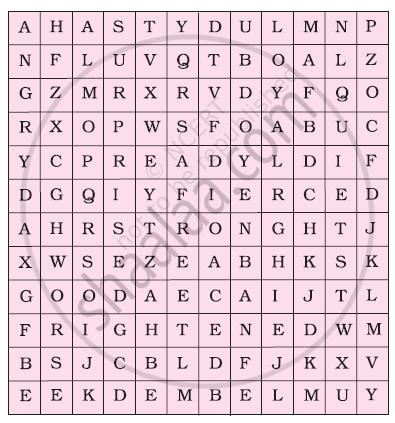
Write True or False against the following statement.
Peter is an only child.
Why does the rebel choose to Wear fantastic Clothes?
Add im- or in- to each of the following words and use them in place of the italicised words in the sentences given below.
| patient, proper, possible, sensitive, competent |
He lacks competence. That’s why he can’t keep any job for more than a year.
Read the following sets of words loudly and clearly.
cot – coat
cost – coast
tossed – toast
got – goat
rot – rote
blot – bloat
knot – note
