Advertisements
Advertisements
प्रश्न
Thinking about the Poem
How does the woodpecker get her food?
Advertisements
उत्तर
The woodpecker gets her food by boring holes into trees.
संबंधित प्रश्न
Expressions used to show fear
Can you find the expressions in the story that tell you that the author was frightened?
Read the story and complete the following sentences.
1. I was turned ______.
2. I sat there holding ______.
3. In the light of the lamp I sat there like ______.
“A slumber did my spirit seal,” says the poet. That is, a deep sleep ‘closed off’ his soul (or mind). How does the poet react to his loved one’s death? Does he feel bitter grief? Or does he feel a great peace?
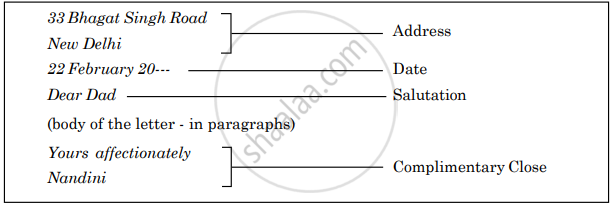
When we write informal letters (to a friend, or to a member of our family), we use this layout.
Of the seven hundred villages dotting the map of India, in which the majority of India’s five hundred million live, flourish and die, Kritam was probably the tiniest, indicated on the district survey map by a microscopic dot, the map being meant more for the revenue official out to collect tax than for the guidance of the motorist, who in any case could not hope to reach it since it sprawled far from the highway at the end of a rough track furrowed up by the iron-hooped wheels of bullock carts. But its size did not prevent its giving itself the grandiose name Kritam, which meant in Tamil coronet or crown on the brow of the subcontinent. The village consisted of fewer than thirty houses, only one of them built from brick and cement and painted a brilliant yellow and blue all over with
gorgeous carvings of gods and gargoyles on its balustrade, it was known as the Big House. The other houses, distributed in four streets, were generally of bamboo thatch, straw, mud and other unspecified material. Muni’s was the last house in the fourth street, beyond which stretched the fields. In his prosperous days Muni had owned a flock of sheep and goats and sallied forth every morning driving the flock to the highway a couple of miles away.
Read the extract given below and answer the question that follow.
How many houses were there in the village?
Mr. Oliver, an Anglo-Indian teacher, was returning to his school late one night on the outskirts of the hill station of Shimla. The school was conducted on English public school lines and the boys – most of them from well-to-do Indian families – wore blazers, caps and ties. “Life” magazine, in a feature on India, had once called this school the Eton of the East.
Mr. Oliver had been teaching in this school for several years. He’s no longer there. The Shimla Bazaar, with its cinemas and restaurants, was about two miles from the school; and Mr. Oliver, a bachelor, usually strolled into the town in the evening returning after dark, when he would take short cut through a pine forest.
Read the extract given below and answer the question that follow.
Who was Mr Oliver? Where was he working?
This woman had been despised, scoffed at, and angrily denounced by nearly every man, woman, and child in the village; but now, as the fact of, her death was passed from lip to lip, in subdued tones, pity took the place of anger, and sorrow of denunciation.
Neighbours went hastily to the old tumble-down hut, in which she had secured little more than a place of shelter from summer heats and winter cold: some with grave-clothes for a decent interment of the body; and some with food for the half-starving children, three in number. Of these, John, the oldest, a boy of twelve, was a stout lad, able to earn his living with any farmer. Kate, between ten and eleven, was bright, active girl, out of whom something clever might be made, if in good hands; but poor little Maggie, the youngest, was hopelessly diseased. Two years before a fall from a window had injured her spine, and she had not been able to leave her bed since, except when lifted in the arms of her mother.
“What is to be done with the children?” That was the chief question now. The dead mother would go underground, and be forever beyond all care or concern of the villagers. But the children must not be left to starve.
Read the extract given below and answer the question that follow.
Describe the three children.
I was in for a surprise. When the time came for the broad-jump trials, I was startled to see a tall boy hitting the pit at almost 26 feet on his practice leaps! He turned out to be a German named Luz Long. 1 was told that Hitler hoped to win the jump with him. I guessed that if Long won, it would add some new support to the Nazis’ “master race” (Aryan superiority) theory. After all, I am a Negro. Angr about Hitler’s ways, 1 determined to go out there and really show Der Fuhrer and his master race who was superior and who wasn’t. An angry athlete is an athlete who will make mistakes, as any coach will tell you. I was no exception. On the first of my three qualifying jumps, I leaped from several inches beyond the takeoff board for a foul. On the second jump, I fouled even worse. “Did I come 3,000 miles for this?” I thought bitterly. “To foul out of the trials and make a fool of myself ?” Walking a few yards from the pit, 1 kicked disgustedly at the dirt.
Read the extract given below and answer the question that follow.
What shattered the confidence of Jesse Owens?
“Do the scientists really know? Will it happen today, will it ?”
“Look, look; see for yourself !”The children pressed to each other like so many roses, so many weeds, intermixed, peering out for a look at the hidden sun. It rained. It had been raining for seven years; thousands upon thousands of days compounded and filled from one end to the other with rain, with the drum and gush of water, with the sweet crystal fall of showers and the concussion of storms so heavy they were tidal waves come over the islands. A thousand forests had been crushed under the rain and grown up a thousand times to be crushed again. And this was the way life was forever on the planet Venus, and this was the schoolroom of the children of the rocket men and women who had come to a raining world to set up civilization and live out their lives.
Read the extract given below and answer the question that follow.
What is the weather like on Venus? How long has it been like this?
Who had agreed to act as an intermediary between the Animal Farm and the outside world ' Describe h~
Why did the king want to know answers to three questions?
The king had done right things at the right time. Explain giving three examples.
How did the bear grow up a vegetarian?
What does the last sentence of the story suggest? What would the crocodile tell his wife?
In what way is Pambupatti different from any other village?
Which line in the poem suggests that you need a keen eye and a sharp ear to enjoy a meadow? Read aloud the stanza that contains this line.
Word in the box given below indicates a large number of… For example, ‘a herd of cows’ refers to many cows.
Complete the following phrase with a suitable word from the box.
a _________________ of ships
Multiple Choice Question:
A house becomes a home with ________
Read the first and second stanzas of the poem again. Note the following phrases.
Corn growing, people working or dancing, wind sighing, rain falling, a singer chanting
These could be written as
-
Corn that is growing
-
People who are working or dancing
Can you rewrite the other phrases like this? Why do you think the poet uses the shorter phrases?
Multiple Choice Question:
What is the significance of four o'clock?
Complete the following sentences from memory choosing a phrase from those given in brackets.
Uncle told me ______ while he was away.
