Advertisements
Advertisements
प्रश्न
Which property of DNA double helix led Watson and Crick to hypothesise semi-conservative mode of DNA replication? Explain.
Advertisements
उत्तर
Watson and Crick proposed a semi-conservative mode of DNA replication based on the molecule’s antiparallel, double-stranded structure. They suggested that the two strands of the DNA molecule uncoil and separate, with each strand serving as a template for the production of a new (complementary) strand alongside it. The template and its complement then combine to generate a new double-stranded DNA molecule identical to the original. The sequence of bases that should be present in the new strands is easily predicted because they will be complementary to the bases present in the old strands. A will partner with T, T with A, C with G, and G with C. As a result, two daughter DNA molecules are created that are identical to the parent molecule; each daughter DNA molecule consists of one new and one old strand. This replication mechanism is referred to as semi-conservation because each daughter molecule contains only one conserved parent strand. Later, experiments by Joseph Taylor, Meselson and Stahl verified it.
APPEARS IN
संबंधित प्रश्न
If a double stranded DNA has 20 per cent of cytosine, calculate the per cent of adenine in the DNA.
One turn of DNA possesses ______.
In some viruses, RNA is present instead of DNA indicating that ______.
A nucleoside differs from a nucleotide. It lacks the ______.
Both deoxyribose and ribose belong to a class of sugars called ______.
The fact that a purine base always paired through hydrogen bonds with a pyrimidine base leads to, in the DNA double helix ______.
While analysing the DNA of an organism a total number of 5386 nucleotides were found out of which the proportion of different bases were: Adenine = 29%, Guanine = 17%, Cytosine = 32%, Thymine = 17%. Considering the Chargaff’s rule it can be concluded that ______.
What is the nature of the strands of the DNA duplex?
If 30 percent of an organism’s DNA is thymine, then ______.
H-bonds between Cytosine and Guanine are ______.
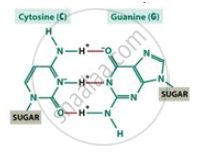
By which bonds the purine and pyrimidine pairs of Complementary Strands of DNA held together?
DNA is made of two chains that twist about one another in the shape of a ______.
Which of the following is a structural subunit of DNA?
A peptide chain assumes secondary structure through the formation of ______.
In the polynucleotide chain of DNA, a nitrogenous base is linked to the -OH of ______
What is the smallest part of a DNA molecule that can be changed by a point mutation?
Polymerase chain reaction (PCR) amplifies DNA following the equation.
Which of the following nitrogenous bases is classified as a purine with a double-ring structure?
What type of bond connects a nitrogenous base to the pentose sugar in a nucleotide?
Which end of a polynucleotide chain contains a free phosphate group?
Which of the following nitrogenous bases is classified as a purine with a double-ring structure?
In a polynucleotide chain, nucleotides are linked together by which type of bond?
Which end of a polynucleotide chain contains a free phosphate group?
In a DNA double helix, what is the spatial relationship between the two polynucleotide strands?
A dinucleotide is formed by linking two nucleotides together. The bond formed between them is:
