Advertisements
Advertisements
प्रश्न
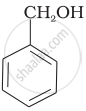
Which of the following compounds is aromatic alcohol?
| (A) | ![]() |
| (B) | ![]() |
| (C) | ![]() |
| (D) | ![]() |
पर्याय
A, B, C, D
A, D
B, C
A
Advertisements
उत्तर
B, C
Explanation:
Compound (A) i.e., phenol and compound (D) i.e., a derivative of phenol cannot be considered as aromatic alcohol. As phenol is also known as, carbolic acid cannot be considered as aromatic alcohol.
Compound (B) and (C), –OH group is bonded to sp3 hybridised carbon which in turn is bonded to benzene ring.
APPEARS IN
संबंधित प्रश्न
Write the structures of A, B, C, D and E in the following reactions:

Write the equation involved in the following reaction:
Kolbe’s reaction
While separating a mixture of ortho and para nitrophenols by steam distillation, name the isomer which will be steam volatile. Give reason.
Explain the following with an example.
Kolbe’s reaction.
Write the reaction involved in the following:
Friedal-Crafts Alkylation of Phenol
Picric acid is ____________.
When phenol is treated with excess bromine water, it gives:
When phenol is heated with CHCl3 and alcoholic KOH when salicylaldehyde is produced. This reaction is known as ____________.
In the reaction of phenol with CHCl3 and aqueous NaOH at 343 K, the electrophile attacking the ring is:
When Phenol is distilled with zinc dust, it gives:
The electrophile involved in Reimer-Tiemann reaction of phenol with CHCl3 in presence of NaOH:

Phenol does not undergo nucleophilic substitution reaction easily due to ______.
Nitration is an example of aromatic electrophilic substitution and its rate depends upon the group already present in the benzene ring. Out of benzene and phenol, which one is more easily nitrated and why?
Convert the following:
Phenol to N-phenylethanamide.
Which of the following is not aromatic?
Which of the following reacts with phenol to give salicylaldehyde after hydrolysis?
For the pair phenol and cyclohexanol, answer the following:
Give one chemical test to distinguish between the two.