What type of bond is present in oxygen?
Advertisements
Advertisements
प्रश्न
What type of bond is present in oxygen?
Advertisements
उत्तर
A covalent bond is the chemical bond present in an oxygen molecule.
संबंधित प्रश्न
What are covalent compounds?
Butanone is a four-carbon compound with the functional group:
Name the black substance of pencil. Will the current flow through the electrical circuit when we use the sharpened ends of the pencil to complete the circuit?
What type of bond is present in the following molecule?
Cl2
In forming oxygen molecule, ______ electrons are shared by each atom of oxygen.
Why does carbon form compounds mainly by covalent bonding?
State one test by which sodium chloride can be distinguished from sugar.
Explain why, ionic compounds conduct electricity in solution whereas covalent compounds do not conduct electricity.
Give the formula of the compound that would be formed by the combination of the following pair of elements:
Al and Cl2
Using electron-dot diagrams which show only the outermost shell electrons, show how a molecule of nitrogen, N2, is formed from two nitrogen atoms. What name is given to this type of bonding?
(Atomic number of nitrogen is 7)
Draw the electron-dot structure of the following compound and state the type of bonding in the given case:
HCl
Explain why, diamond can be used in rock drilling equipment but graphite cannot.
Why is graphite a good conductor of electricity but diamond is a non-conductor of electricity?
Why are covalent compounds generally poor conductors of electricity?
One of the following is not an allotrope of carbon. This is:
State the type of bonding in the following molecule.
Water
Draw an electron dot structure of the following molecule. (Without showing the circle) :
Methane
Explain the Structural isomerism term with example.
Molecular formula of Propane is C3H8 , write the structural formula of propane.
What do you understand by lone pair?
Name a neutral covalent molecule which contains one lone pair of electrons.
Draw an electron dot diagram to show the formation of the following compound.
Magnesium chloride
[Mg = 12, Cl = 17]
Electrons are getting added to an element Y:
Is Y getting oxidised or reduced?
Draw the electron dot diagram and structure of magnesium chloride.
What do you understand by dipole (polar) molecule?
Taking MgCl2 as an electrovalent compound, CCl4 as a covalent compound, give four difference between electrovalent and covalent compounds
Generally, the melting and boiling point of carbon compounds are found to be less than _______ °C.
From the following hydrocarbon _______ is the cyclic hydrocarbon.
The number of electrons in the valence shell of a carbon atom is 4.
Explain covalent bond with example.
Complete the following activity.
Write the names of the hydrocarbons for the following structural formula.
(isobutylene, cyclohexane, propene, cyclohexene, cyclopentane, benzene, propyne, isobutane, propane)
| \[\begin{array}{cc}\ce{H}\phantom{...}\ce{H}\phantom{...}\ce{H}\\ |\phantom{....}|\phantom{....}|\\\ce{H - C - C - C - H}\\ |\phantom{....}|\phantom{....}|\\\ce{H}\phantom{...}\ce{H}\phantom{...}\ce{H} \end{array}\] |
Complete the following activity.
Write the names of the hydrocarbons for the following structural formula.
(isobutylene, cyclohexane, propene, cyclohexene, cyclopentane, benzene, propyne, isobutane, propane)
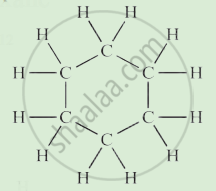 |
Complete the following activity.
Write the names of the hydrocarbons for the following structural formula.
(isobutylene, cyclohexane, propene, cyclohexene, cyclopentane, benzene, propyne, isobutane, propane)
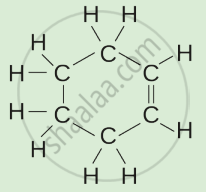 |
Discuss in brief about the properties of coordinate covalent compounds.
The number of pi-bonds present in benzoic acid molecule are ______.
Carbon forms four covalent bonds by sharing its four valence electrons with four univalent atoms, e.g., hydrogen. After the formation of four bonds, carbon attains the electronic configuration of ______.
Two carbon atoms can always form one or two covalent bonds.
Oils on treating with hydrogen in the presence of palladium or nickel catalyst form fats. This is an example of
Mineral acids are stronger acids than carboxylic acids because
- mineral acids are completely ionised
- carboxylic acids are completely ionised
- mineral acids are partially ionised
- carboxylic acids are partially ionised
The bond which is formed by the mutual sharing of electrons is called ______ bond.
