Advertisements
Advertisements
प्रश्न
What type of chemical bonds are formed by carbon? Why?
Advertisements
उत्तर
Carbon always forms covalent bonds. This is because it is tetravalent and attain the inert gas configuration of 8 electrons in its outermost shell by sharing electrons.
APPEARS IN
संबंधित प्रश्न
Why covalent compounds are different from ionic compounds?
What would be the electron dot structure of carbon dioxide which has the formula CO2?
Choose the most appropriate answer from the following list of oxides which fit the description.
A covalent oxide of a metalloid.
Buckminsterfullerene is spherical molecule in which 60 carbon atoms are arranged in interlocking hexagonal and pentagonal rings of carbon atoms.
How many hexagons of carbon atoms are present in one molecule of buckminsterfullerene?
What type of chemical bond is present in chlorine molecule? Explain your answer.
Explain why, ionic compounds conduct electricity in solution whereas covalent compounds do not conduct electricity.
Friedrich Wohler converted an inorganic compound into an organic compound in the laboratory.
Write the name and formula of organic compound formed.
Give the formula of the compound that would be formed by the combination of the following pair of elements:
K and H
What is diamond? Of what substance is diamond made?
One of the following compounds is not ionic in nature. This compound is:
(a) Lithium chloride
(b) Ammonium chloride
(c) Calcium chloride
(d) Carbon tetrachloride
An element A has 4 valence electrons in its atom whereas element B has only one valence electron in its atom. The compound formed by A and B does not conduct electricity. What is the nature of chemical bond in the compound formed? Give its electron-dot structure.
What are the conditions necessary for the formation of covalent molecules?
Give two example in following case:
Gaseous non polar compounds
Explain the following term with example.
Covalent bond
Explain the following term with example.
Homopolymer
The carbon compound is used in daily life is ______.
Compare the compounds carbon tetrachloride and sodium chloride with regard to solubility in water and electrical conductivity.
Write scientific reason.
Carbon has the property of forming many compounds.
Complete the following activity.
Write the names of the hydrocarbons for the following structural formula.
(isobutylene, cyclohexane, propene, cyclohexene, cyclopentane, benzene, propyne, isobutane, propane)
| \[\begin{array}{cc} \phantom{..}\ce{H}\phantom{...}\ce{H}\phantom{...}\ce{H}\\ \phantom{..}|\phantom{....}|\phantom{....}|\\ \ce{H - C - C- C- H}\\ \phantom{.}|\phantom{....}|\phantom{....}|\\ \ce{H - C - H}\\ |\\\ce{H}\end{array}\] |
Complete the following activity.
Write the names of the hydrocarbons for the following structural formula.
(isobutylene, cyclohexane, propene, cyclohexene, cyclopentane, benzene, propyne, isobutane, propane)
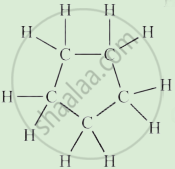 |
