Advertisements
Advertisements
प्रश्न
What reasons does he give to Sergei for his telling lies?
Advertisements
उत्तर
He told Sergei that he could not get along without lying. If he told the truth, then nobody would give him anything.
संबंधित प्रश्न
While packing the hamper, George and Harris do a number of foolish and funny thing. Tick the statements that are true.
(i) They started with breaking a cup.
(ii) They also broke a plate.
(iii) They squashed a tomato.
(iv) They trod on the butter.
(v) They stepped on a banana.
(vi) They put things behind them, and couldn’t find them.
(vii) They stepped on things.
(viii) They packed the pictures at the bottom and put heavy things on top.
(ix) They upset almost everything.
(x) They were very good at packing.
Thinking about Language
Match the words/phrases in Column A with their meanings in Column B.
| A | B |
| 1. slaving | (i) a quarrel or an argument |
| 2. cgaos | (ii) remove something from inside another thing using a sharp tool |
| 3. rummage | (iii) strange, mysterious. Difficult to explain |
| 4. scrape out | (iv) finish successfully, achieve |
| 5. stumble over, tumble into |
(v) search for something by moving things around hurriedly or carelessly |
| 6. accomplish | (vi) completer confusion and disorder |
| 7. uncanny | (vii) fall, or step awkwardly while waking |
| 8. (to have or get into) a | (viii) working hard |
Thinking about Poem
What does he mean by “the strength of the tree exposed”?
How does the guru mange to save his disciple’s life?
Based on your reading of the story answer the following question by choosing the correct option:
With reference to Hooper, the author says, “Every thing was going for him”. What does it imply?
In groups of six, work on one of the mysteries given below by surfing the net and through other sources. Create a power point presentation/a photo essay.
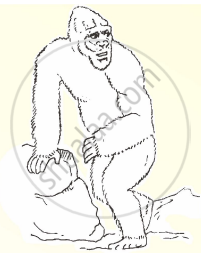
- Yeti, the abominable snowman
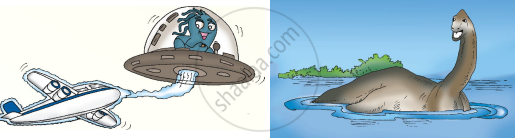
- Loch Ness Monster
- UFOs (Unidentified Flying Objects)
- Lost city of Atlantis
- Crop circles
- Nazca lines
Oh yes, we know it keeps them still,
They don't climb out the window sill,
They never fight or kick or punch,
They leave you free to cook the lunch
And wash the dishes in the sink....
But did you ever stop to think,
To wonder just exactly what
This does to your beloved tot?
IT ROTS THE SENSE IN THE HEAD!
IT KILLS IMAGINATION DEAD!
IT CLOGS AND CLUTTERS UP THE MIND!
IT MAKES A CHILD SO DULL AND BLIND
HE CAN NO LONGER UNDERSTAND
A FANTASY, A FAIRYLAND!
HIS BRAIN BECOMES AS SOFT AS CHEESE!
HIS POWERS OF THINKING RUST AND FREEZE!
HE CANNOT THINK - HE ONLY SEES!
Read the lines given above and answer the question given below.
How are televisions helpful to parents?
The blocks were all lined up for those who would use them
The hundred-yard dash and the race to be run
These were nine resolved athletes in back of the starting line
Poised for the sound of the gun.
The signal was given, the pistol exploded
And so did the runners all charging ahead
But the smallest among them,he stumbled and staggered
And fell to the asphalt instead.
He gave out a cry in frustration and anguish
His dreams ands his efforts all dashed in the dirt
But as sure I'm standing here telling this story
The same goes for what next occurred.
Read the lines given above and answer the following question:
Who do you think are the competitors? How do you know which is the event mentioned?
The village consisted of less than thirty houses, only one of them built with brick and cement. Painted a brilliant yellow and blue all over with gorgeous carvings of gods and gargoyles on its balustrade, it was known as the Big House. The other houses, distributed in four streets, were generally of bamboo thatch, straw, mud, and other unspecified material. Muni’s was the last house in the fourth street, beyond which stretched the fields. In his prosperous days Muni had owned a flock of forty sheep and goats and sallied forth every morning driving the flock to the highway a couple of miles away.
Read the extract given below and answer the question that follow.
What is the name of the village referred to here? Where is it situated?
She again rubbed a match on the wall, and the light shone round her; in the brightness stood her old grandmother, clear and shining, yet mild and loving in her appearance. “Grandmother,” cried the little one, “O take me with you; I know you will go away when the match burns out; you will vanish like the warm stove, the roast goose, and the large, glorious Christmas-tree.” And she made haste to light the whole bundle of matches, for she wished to keep her grandmother there. And the matches glowed with a light that was brighter than the noon-day, and her grandmother had never appeared so large or so beautiful. She took the little girl in her arms, and they both flew upwards in brightness and joy far above the earth, where there was neither cold nor hunger nor pain, for they were with God.
In the dawn of morning there lay the poor little one, with pale cheeks and smiling mouth, leaning against the wall; she had been frozen to death on the last evening of the year; and the New-year’s sun rose and shone upon a little corpse! The child still sat, in the stiffness of death, holding the matches in her hand, one bundle of which was burnt. “She tried to warm herself,” said some. No one imagined what beautiful things she had seen, nor into what glory she had entered with her grandmother, on New-year’s day.
Read the extract given below and answer the question that follow.
Why was there a smile on the girl’s lips? Did the people understand?
The women came out on the shore, and made for the stepping—?stones. They had plenty to laugh and bicker about, as they approached the river in a noisy crowd. They girded up their skirts, so as to jump from stone to stone, and they clanked their sickles and forks together over their shoulders to have ease of movement. They shouted their quarrels above the gush of the river. Noise frightens crocodiles. The big mugger did not move, and all the women crossed in safety to the other bank. Here they had to climb a steep hillside to get at the grass, but all fell to with a will, and sliced away at it wherever there was foothold to be had. Down below them ran the broad river, pouring powerfully out from its deep narrow pools among the cold cliffs and shadows, spreading into warm shallows, lit by kingfishers. Great turtles lived there, and mahseer weighing more than a hundred pounds. Crocodiles too. Sometimes you could see them lying out on those slabs of clay over there, but there were none to be seen at the moment.
Read the extract given below and answer the question that follow.
Why did they shout louder than the sound of the water?
As it turned out, Luz broke his own past record. In doing so, he pushed me on to a peak performance. I remember that at the instant I landed from my final jump—the one which set the Olympic record of 26 feet 5-5/16 inches—he was at my side, congratulating me. Despite the fact that Hitler glared at us from the stands not a hundred yards away, Luz shook my hand hard—and it wasn’t a fake “smile with a broken heart” sort of grip, either.
You can melt down all the gold medals and cups I have, and they couldn’t be a plating on the 24-carat friendship I felt for Luz Long at that moment. I realized then, too, that Luz was the epitome of what Pierre de Coubertin, founder of the modern Olympic Games, must have had in mind when he said, “The important thing in the Olympic Games is not winning but taking part. The essential thing in life is not conquering but fighting well.”
Read the extract given below and answer the question that follow.
What do you understand of Hitler from Jesse’s account?
Analyze the character of Luz Long.
Do the following activity in groups.
Go to the library and collect information about the lifestyle of people in desert areas— their food, clothes, work, social customs, etc. Share this information with the group.
Answer the following question.
Why did Golu go to the river?
What did Number One and Number Two suggest should be done about the alien spacecraft?
Talk to your partner and say whether the following statement is true or false.
Camels store water in their humps.
Answer the following question.
What was Algu’s verdict as head Panch? How did Jumman take it?
The word ‘tip’ has only three letters but many meanings.
Match the word with its meanings below.
- finger tips – be about to say something
- the tip of your nose – make the boat overturn
- tip the water out of the bucket – the ends of one’s fingers
- have something on the tip of your tongue – give a rupee to him, to thank him
- tip the boat over-empty a bucket by tilting it
- tip him a rupee-the pointed end of your nose
- the tip of the bat – if you take this advice
- the police were tipped off – the bat lightly touched the ball
- if you take my tip – the end of the bat
- the bat tipped the ball – the police were told or warned
What does Cares say to bless the young couple?
