Advertisements
Advertisements
प्रश्न
What is the action of following reagents on glucose?
1. Bromine water
2. Hydroxylamine
Advertisements
उत्तर
1. Action of bromine water on glucose:
The oxidation of glucose wirh bromine water (which is a mild oxidizing agent) gives gluconic acid. This indicates the presence of aldehyde group.
\[\begin{array}{cc}
\phantom{.........}\ce{CHO}\phantom{......................}\ce{COOH}\phantom{.............}\\
\phantom{}|\phantom{............................}|\phantom{......}\\
\ce{(CHOH)4 + [O] ->[Bromine water] (CHOH)4}\\
\phantom{.........}|\phantom{.............................}|\phantom{...............}\\
\phantom{...............}\ce{\underset{\text{Glucose}}{CH2OH}}\phantom{.......................}\ce{\underset{\text{Gluconic acid}}{CH2OH}}\phantom{...............}
\end{array}\]
2. Action of hydroxylamine on glucose:
The reaction of glucose with hydroxylamine gives glucoxime. This indicates the presence of carbonyl group.
\[\begin{array}{cc}
\phantom{....................}\ce{CHO}\phantom{.........................}\ce{CH = N - OH }\phantom{.............}\\
\phantom{...}|\phantom{............................}|\phantom{......}\\
\ce{(CHOH)4 ->[NH2-OH] (CHOH)4 + H2O}\\
\phantom{.............}|\phantom{.............................}|\phantom{...............}\\
\phantom{................}\ce{\underset{\text{Glucose}}{CH2OH}}\phantom{....................}\ce{\underset{\text{Glucoxime}}{CH2OH}}\phantom{...............}
\end{array}\]
APPEARS IN
संबंधित प्रश्न
On acid hydrolysis, propane nitrile gives.
Identify ‘A' and ‘B’ in the following reaction :
C6H5MgBr + C02 `(`> ‘A’ `(PCl_5)/()`> ‘B’
Write the structures of A and B in the following reactions

Name the reagents used in the following reactions:

Show how the following compound can be converted to benzoic acid.
Acetophenone
Show how the following compound can be converted to benzoic acid.
Phenylethene (Styrene)
How will you prepare the given compound from benzene? You may use any inorganic reagent and any organic reagent having not more than one carbon atom.
Methyl benzoate
How will you prepare the given compound from benzene? You may use any inorganic reagent and any organic reagent having not more than one carbon atom.
m-Nitrobenzoic acid
How will you prepare the given compound from benzene? You may use any inorganic reagent and any organic reagent having not more than one carbon atom.
p-Nitrobenzoic acid
Complete the synthesis by giving missing starting material, reagent or product.
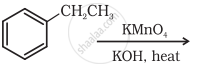
How is methoxy benzene prepared from carbolic acid?
Name the reagents used in the following reactions:

The reagent which does not react with both, acetone and benzaldehyde.
Assertion: Aldehydes and ketones, both react with Tollen’s reagent to form silver mirror.
Reason: Both, aldehydes and ketones contain a carbonyl group.
Substitution of one alkyl group by replacing hydrogen of primary amines
Match List - I with List - II.
| List - I | List - II | ||
| (a) |  \[\ce{->[CO,HCl][Anhyd. AlCl3/CuCl]}\] |
(i) | Hell-Volhard-Zelinsky reaction |
| (b) |
\[\begin{array}{cc}
\ce{O}\phantom{.................}\\ ||\phantom{.................}\\ \ce{R - C - CH3 + NaOX ->} \end{array}\] |
(ii) | Gattermann-Koch reaction |
| (c) | \[\ce{R - CH2 - OH + R'COOH ->[Conc. H2SO4]}\] | (iii) | Haloform reaction |
| (d) | \[\ce{R - CH2COOH ->[(i) X2/Red P][(ii) H2O]}\] | (iv) | Esterification |
Choose the correct answer from the options given below.
The end product Y in the sequence of reaction:
\[\ce{RX ->[CN^-] X ->[NaOH] Y}\] is:
Alkaline hydrolysis of C4H8Cl2 gives a compound (A) which on heating with NaOH and I2 produces a yellow precipitate of CHI3. The compound (A) should be ______.
Hex-4-ene-2-ol on treatment with PCC gives 'A'. 'A' on reaction with sodium hypoiodite gives 'B', which on further heating with soda lime gives 'C. The compound 'C' is ______.
Fill in the blanks by choosing the appropriate words from those given in the brackets:
[stable, low, aldehyde, unstable, 6, 4, ethane, Clemmensen’s, 2, 3, carboxylic acid, high, propane, Rosenmund's]
The primary alcohols are easily oxidised first into ______ and then into ______.
