Advertisements
Advertisements
प्रश्न
Advertisements
उत्तर
The turning effect produced by a force on a rigid body about a point, pivot or fulcrum is called the moment of force or torque. It is measured by the product of force and the perpendicular distance of the pivot from the line of action of the force.
Moment of a force = Force × perpendicular distance of the pivot from the force.
Its SI unit is newton-metre (Nm).
APPEARS IN
संबंधित प्रश्न
What is the SI unit of the moment of force?
A half metre rod is pivoted at the centre with two weights of 20gf and 12gf suspended at a perpendicular distance of 6 cm and 10 cm from the pivot respectively as shown below.
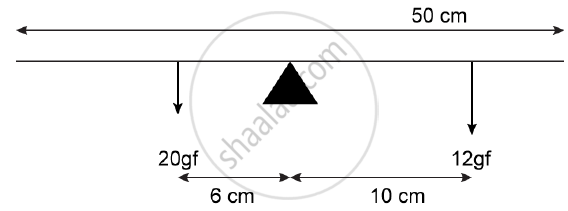
1) Which of the two forces acting on the rigid rod causes clockwise moment?
2) Is the rod in equilibrium?
3) The direction of 20 kgf force is reversed. What is the magnitude of the resultant moment of the forces on the rod?
How does the effect of force differ when it is applied on a rigid body?
Classify the following amongst contact and non-contact forces.
Frictional force
Define non-contact forces.
State when the moment of force is positive and when it is negative.
Two unlike forces (parallel) of 10 N and 25 N act at a distance of 12 cm. from each other. Find the point about which the body balance.
The perpendicular distance between the point of application of force and turning point is 1.75 m when a force of 80 N acts on a rigid body. Calculate the moment of force.
Calculate the magnitude of the force of a couple, when the arm of the couple is 63 cm and the moment of the couple is 21 Nm.
The diagram shows wheel O pivoted at point A. Three equal forces F1, F2 and F3 act at point B on the wheel.

- Which force will produce maximum moment about A?
- Give a reason for your answer in (a).
