Advertisements
Advertisements
प्रश्न
Advertisements
उत्तर
Transpiration: It is the loss of water in the form of water vapour usually during day time.
Following are its importance in plants:
1. It causes transpirational pull which helps in the absorption of water.
2. It produces a cooling effect.
3. It helps in the ascent of sap.
APPEARS IN
संबंधित प्रश्न
Transpiration helps in creating ______ force and in eliminating excess ______.
Which of the following statements are true and which ones are false? Give reason in support of your answer.
Atmospheric humidity promotes transpiration from a green plant.
Briefly explain how the rate of transpiration is affected by
Intensity of light
Answer the following (only in few words);
When does stomatal transpiration take place in plants?
The diagram alongside represents a structure found in a leaf. Study the same and answer the questions that follow:
(i) Name the parts labeled A and B.
(ii) What is the biological term for the above structure?
(iii) What is the function of the part labeled A?
(iv) Mention two structural features of A, which help in the function mentioned in (iii) above?
(v) Where is this structure likely to be found in a leaf?
(vi) The structure (fig.5.22) helps in the process of transpiration. Explain the term transpiration.
(vii) How many other cells are found surrounding this structure as seen in the diagram?

Differentiate Between Transpiration and Guttation.
Study the diagram given below and answer the questions that follow:
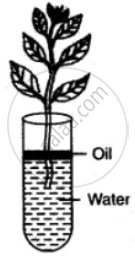
(i) Name the process being studied in the above experiment.
(ii) Explain the process mentioned in (i) above.
(iii) Why is oil placed over water?
Name the following:
Holes present on the surface of the stems and twigs for transpiration.
Give a reason/suitable explanation.
Forests tend to bring more rains.
An outline sketch of a tree is shown in a diagram below. Study the same and answer the questions that follow:

- Name and define the phenomenon labelled A in the diagram.
- Write the significance of the process mentioned in A for the plants.
- What do the direction of the arrows in B and C indicate? Name the phenomena.
- Draw a neat and labelled diagram of an opened stomata.
