Advertisements
Advertisements
प्रश्न
Advertisements
उत्तर
APPEARS IN
संबंधित प्रश्न
Explain the principle of a hydraulic machine. Name two devices which work on this principle.
The area of cross-sections of the pump plunger and press plunger of a hydraulic press is 0.02 m2 and 8 m2 respectively. If the hydraulic press overcomes a load of 800 kgf, calculate the force acting on the pump plunger.
The pressure in the water pipe on the ground floor of a building is 40000 pascals, whereas on the first floor it’s 10000 pascals. Find the height of the first floor. (Acceleration due to gravity g = 10 ms−2)
P is the pressure at some point in a liquid. State whether pressure P is a scalar or vector quantity.
How does the liquid pressure on a diver change according to the following condition:
When the driver moves to the greater depth?
The following figure shows a manometer containing a liquid of density p. The limb P of the manometer is connected to a vessel V and the limb Q is open to atmosphere. The difference in the levels of liquid in the two limbs of the manometer is h as shown in the diagram. The atmospheric pressure is P0.
(i) What is the pressure on the liquid surface in the limb Q?
(ii) What is the pressure on the liquid surface in the limb P?

State Pascal's law.
State two applications of Pascal's law.
The density of iron is 7800 kg m-3. What do you mean by this statement? What is density of water at 40C?
Consider a water tank shown in the figure. It has one wall at x = L and can be taken to be very wide in the z direction. When filled with a liquid of surface tension S and density ρ, the liquid surface makes angle θ(θ << 1) with the x-axis at x = L. If y(x) is the height of the surface then the equation for y(x) is:
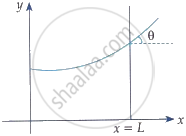
(take θ(x) = sin θ(x) = tan θ(x) = `dy/dx`, g is the acceleration due to gravity)
