Advertisements
Advertisements
प्रश्न
What is a trophic level?
Advertisements
उत्तर
Trophic levels are the feeding positions of organisms within a food chain, with producers at the base, followed by herbivores and successive levels of carnivores. Each level represents a stage in the transfer of energy and food. An organism can occupy multiple trophic levels depending on what it eats.
APPEARS IN
संबंधित प्रश्न
Why are plants called producers?
Name the organisms belonging to the second and the fourth trophic levels in the food chain comprising the following :
Frogs, Plants, Snakes, Hawk, Insects
Fill in the following blank with suitable word :
Decomposer organisms are..........in their action.
Can the organisms of any trophic level be removed without causing any damage to the ecosystem? Will the impact of removing all the organisms in a trophic level be different for different trophic levels?
What is a food chain?
What is a 'food web'? Show its formation.
Organisms which synthesise carbohydrates from inorganic compounds by using radiant energy are called ______.
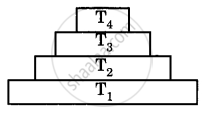
In the figure given alongside, the various trophic levels are shown in the form of a pyramid. At which trophic level the maximum energy is available?
A food chain occurring in the sea which provides food for many people can be written as :
phytoplankton → zooplankton → X → Y
What could be X?
A food chain occurring in the sea which provides food for many people can be written as :
phytoplankton → zooplankton → X → Y
Which organism in the above food chain is a (1) primary consumer, and (2) tertiary consumer?
What would happen to the number of rabbits and grass plants if the number of foxes increased?
If 5 joules of energy is available at producer level (plants), then how much energy will be transferred to the lion in the following food chain?
Plants → Goat → Lion
Why are there rarely more than five links (or five organisms) in a food chain?
Will the levels of biological magnification be different at different levels of the ecosystem?
Explain why, the flow of energy in the ecosystem is said to be unidirectional.
In the food chain given below, if the amount of energy available at fourth trophic level is 5 kJ, what was the energy available at the producer level?
Grass → Grasshopper → Frog → Snake → Hawk
(a) 500 kJ
(b) 50 kJ
(c) 5000 kJ
(d) 5 kJ
What percentage of sun's energy falling on the leaves of green plants is utilised by the plants in the process of photosynthesis and stored as chemical energy of food?
(a) 99 per cent
(b) 10 per cent
(c) 1 per cent
(d) 20 per cent
An aquatic food chain comprises of the organisms like tadpoles, weeds, fish and water beetles. The organism which gets the minimum energy through this food chain is :
(a) water beetles
(b) tadpoles
(c) weeds
(d) fish
If the energy available at the producer level in a food chain is 150 J, how much energy will be transferred to : tertiary consumer?
(a) 15 J
(b) 10 J
(c) 1.50 J
(d) 0.15 J
The harmful chemical which is accumulating in human beings through food chain is :
(a) benzenehexachloride
(b) dichlorodiphenyltrichloroethane
(c) chlorofluorocarbon
(d) abscisic acid
"Energy flow in food chains is always unidirectional". Justify this statement. Explain how the pesticides enter a food chain and subsequently get into our body.
| Human body is made up of five important components, of which water is the main component. Food, as well as potable water, are essential for every human being. The food is obtained from plants through agriculture. Pesticides are being used extensively for a high yield in the fields. These pesticides are absorbed by the plants from the soil along with water and minerals and from the water bodies these pesticides are taken up by the aquatic animals and plants. As these chemicals are not biodegradables, they get accumulated progressively at each trophic level. The maximum concentration of these chemicals gets accumulated in our bodies and greatly affects the health of our mind and body. |
- Why is the maximum concentration of pesticides found in human beings? (1)
- Give one method which could be applied to reduce our intake of pesticides through food to some extent. (1)
- Various steps in a food chain represent: (1)
- Food web
- Trophic level
- Ecosystem
- Biomagnification
- With regard to various food chains operating in an ecosystem, man is a: (1)
- Consumer
- Producer
- Producer and consumer
- Producer and decomposer
In an ecosystem, herbivores represent ______.
Which of the following is an autotroph?
Observe the food web and answer the questions given below:
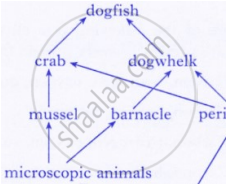
Why do all food chains start with plants?
Natural agents like ______ are the decomposition factors breaking complex forms into simpler units.
______ obtained energy from the chemical breakdown of dead organisms.
In the given food chain, suppose the amount of energy at the fourth trophic level is 5 kJ, what will be the energy available at the producer level?
Grass → Grasshopper → Frog → Snake → Hawk
Use of several pesticides which results in excessive accumulation of pesticides in rivers of ponds, is a matter of deep concern. Justify this statement.
