Advertisements
Advertisements
प्रश्न
What are the different types of joints? Give one example of each type.
Name the different types of joints? Give one example for each type.
Advertisements
उत्तर
|
Types of joints |
Example |
|
Immovable joint |
Skull bones |
|
Partially movable joint |
Joints between vertebrae |
|
Freely movable joint |
Hip joint |
|
Gliding joint |
Ankle bones |
|
Pivot joint |
Joint between atlas and axis vertebrae |
|
Hinge joint |
Elbow |
|
Ball and socket joint |
Shoulder joint |
संबंधित प्रश्न
Name the type of joint between the following:
Between pubic bones in the pelvic girdle
Some people in old age complain of stiff joints. What do you think could be a possible reason for it?
Name any two types of movable joints found in the body of man.
What is the ball and socket joint and where are they present in the body?
Alongside is shown a diagrammatic skeletal of synovial j oint.
(a) What is a synovial joint?
(b) Where do you find such a joint?
(c) What is the function of cartilages?
(d) Name the parts 1 to 5. 2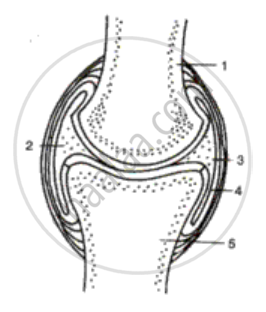
The question has four options. Choose the correct answer:
Which of the following is not true for the elbow joint?
What will happen if there are no joints in our body?
Differentiate between the following.
Ball and socket Joint and hinge Joint
Phalanges refer to bones of the ______.
Synovial fluid helps to reduce friction.
Name two joints with examples.
Which type of movement would have been possible if
our elbow had a fixed joint.
Which of the following joints do not allow any movement?
What is the type of movable joint present between the atlas and axis?
Which one of the following pairs is incorrect?
How do our bone joints function without grinding noise and pain?
Name the type of joint between the following:
Atlas/axis
Name the type of joint between the following:
Carpal/metacarpal of thumb
