Advertisements
Advertisements
प्रश्न
How do our bone joints function without grinding noise and pain?
Advertisements
उत्तर
Our bone joints function without grinding noise and pain due to the presence of synovial fluid between bones.
APPEARS IN
संबंधित प्रश्न
What are the different types of joints? Give one example of each type.
Alongside is shown a diagrammatic skeletal of synovial j oint.
(a) What is a synovial joint?
(b) Where do you find such a joint?
(c) What is the function of cartilages?
(d) Name the parts 1 to 5. 2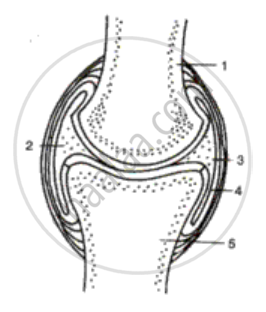
The question has four options. Choose the correct answer:
Which of the following is not true for the elbow joint?
The ______ is seen in fingers and toes.
What will happen if there are no joints in our body?
The place where two bones meet is termed as ______.
Differentiate between the following.
Ball and socket Joint and hinge Joint
The bones at the elbow are joined by a ______ joint.
The finger bones do not have joints.
Phalanges refer to bones of the ______.
Bones are connected to muscles by ______.
An immovable joint is found in the ______.
The joint between the rib and breast bone is a fixed joint.
Name two joints with examples.
Write the type of joint which is used for the following movement:
A cricket bowler bowls the ball.
Unscramble the jumbled word and write it in the blank space provided.
sangro inerlan ................
Match the following and mark the correct option
| Column I | Column II |
| A. Sternum | i. Synovial fluid |
| B. Glenoid Cavity | ii. Vertebrae |
| C. Freely movable joint | iii. Pectoral girdle |
| D. Cartilaginous joint | iv. Flat bones |
Name the type of joint between the following:
Atlas/axis
