Advertisements
Advertisements
प्रश्न
Alongside is shown a diagrammatic skeletal of synovial j oint.
(a) What is a synovial joint?
(b) Where do you find such a joint?
(c) What is the function of cartilages?
(d) Name the parts 1 to 5. 2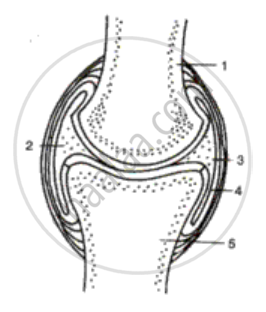
Advertisements
उत्तर
(a) Synovial joint is a movable joint present between the adjoining bones which can move independently. The articulating surfaces of the two bones are covered with articular cartilage. The joint is covered with a synovial membrane which secretes synovial fluid for lubrication.
(b) These are found in elbow joint, knee joint, femur and pelvic girdle, etc.
(c) The cartilages cover the ends of the adjoining bones. They function to absorb shock and reduce friction during movement.
(d) 1 and 5 -epiphyseal bone
2- synovial cavity
3- synovial fluid
4- synovial membrane
APPEARS IN
संबंधित प्रश्न
What is a Joint?
Hinge joint is slightly movable joint.
The bones at the elbow are joined by a ______ joint.
Answer the following:
Why can our elbow not move backwards?
Inflammation of joints can lead to a disease called ______.
The bones need two important minerals which are ______ and ______.
Provide one word answers to the statement given below.
Joint which allows movement in all directions.
What is the type of movable joint present between the atlas and axis?
Match the following and mark the correct option
| Column I | Column II |
| A. Sternum | i. Synovial fluid |
| B. Glenoid Cavity | ii. Vertebrae |
| C. Freely movable joint | iii. Pectoral girdle |
| D. Cartilaginous joint | iv. Flat bones |
Name the type of joint between the following:
Between cranial bones
