Advertisements
Advertisements
प्रश्न
What is the type of movable joint present between the atlas and axis?
पर्याय
Pivot
Saddle
Hinge
Gliding
Advertisements
उत्तर
Pivot
Explanation:
Between atlas and axis called atlanto-axial joint.
APPEARS IN
संबंधित प्रश्न
What are the different types of joints? Give one example of each type.
Alongside is shown a diagrammatic skeletal of synovial j oint.
(a) What is a synovial joint?
(b) Where do you find such a joint?
(c) What is the function of cartilages?
(d) Name the parts 1 to 5. 2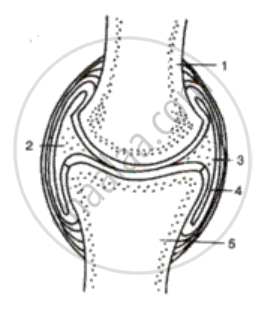
The question has four options. Choose the correct answer:
Which of the following is not true for the elbow joint?
The ______ is seen in fingers and toes.
Draw diagrams.
Types of joints
Why our backbone is slightly moveable?
Joints of the bones help in the ______ of the body.
The greatest range of movement is seen in ______ joint.
There are ______ types of movable joints.
Flat bones are seen in ______.
Match the following
| 1. | Humerus | a. | Forearm |
| 2. | Radius | b. | Leg |
| 3. | Tarsals | c. | Upper arm |
| 4. | Atlas | d. | vertebral column |
How are joints classified? Explain with an example.
Unscramble the jumbled word and write it in the blank space provided.
sangro inerlan ................
Match List - I with List - II.
| List - I | List - II | ||
| (a) | Scapula | (i) | Cartilaginous joints |
| (b) | Cranium | (ii) | Flat bone |
| (c) | Sternum | (iii) | Fibrous joints |
| (d) | Vertebral column | (iv) | Triangular flat bone |
Choose the correct answer from the options given below.
Which one of the following pairs is incorrect?
Knee joint and elbow joint are examples of ______.
Name the type of joint between the following:
Between cranial bones
Match List I with List II.
| List I | List II |
| A. Fibrous joints | I. Adjacent vertebrae, limited movement |
| B. Cartilaginous joints | II. Humerus and Pectoral girdle, rotational movement |
| C. Hinge joints | III. Skull, don’t allow any movement |
| D. Ball and socket joints | IV. Knee, help in locomotion |
Choose the correct answer from the options given below:
