Advertisements
Advertisements
प्रश्न
Using the figures given below, frame problems based on profit percent or loss percent.
Cost price ₹1600, selling price ₹ 2800
Advertisements
उत्तर
A man bought an article for Rs 1600 and sold it for Rs 2800. Find his profit percent.
Cost price of an article = Rs 1600
Selling price of an article = Rs 2800
Since selling price is more than cost price, so there is a profit.
Profit = Selling Price − Cost Price
= 2800 − 1600
= Rs 1200
Let x % be the profit made by the man in this transaction. Then,
`"x"/100 = "profit"/"cost price" = 1200/1600`
`"x"/100 = 1200/1600`
`1200/1600 = 12/16 = 3/4`
`x/100 = 3/4`
`x = 3/4 xx 100 = 75`
∴ The man made a profit of 75% in this transaction.
संबंधित प्रश्न
A dealer buys a wristwatch for Rs 225 and spends Rs 15 on its repairs. If he sells the same for Rs 300, find his profit percent.
Ramesh bought two boxes for Rs 1300. He sold one box at a profit of 20% and the other box at a loss of 12%. If the selling price of both boxes is the same, find the cost price of each box.
Rohit buys an item at 25% discount on the marked price. He sells it for Rs 660, making a profit of 10%. What is the marked price of the item?
What is the marked price of a hat which is bought for ₹ 210 at 16% discount?
Vaidegi sold two sarees for ₹ 2200 each. On one she gains 10% and on the other she loses 12%. Find her total gain or loss percentage in the sale of the sarees
A man bought 400 metre of cloth for ₹ 60,000 and sold it at the rate of ₹ 400 per metre. Find his profit or loss
A TV set was bought for Rs 26,250 including 5% VAT. The original price of the TV set is ______.
Babita bought 160 kg of mangoes at Rs 48 per kg. She sold 70% of the mangoes at Rs 70 per kg and the remaining mangoes at Rs 40 per kg. Find Babita’s gain or loss per cent on the whole dealing.
Brinda purchased 18 coats at the rate of Rs 1,500 each and sold them at a profit of 6%. If customer is to pay sales tax at the rate of 4%, how much will one coat cost to the customer and what will be the total profit earned by Brinda after selling all coats?
Music CD originally priced at Rs 120 is on sale for 25% off. What is the S.P.?
Sonia and Rahul have different ways of calculating the sale price for the items they bought.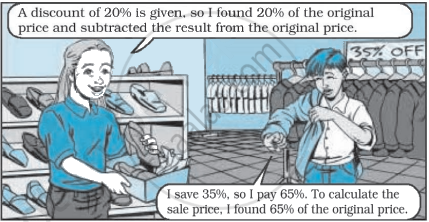
As you work on the next problem, try both of these methods to see which you prefer.
