Advertisements
Advertisements
प्रश्न
Using integration find the area of the triangle formed by positive x-axis and tangent and normal of the circle
`x^2+y^2=4 at (1, sqrt3)`
Advertisements
उत्तर
The given equation of the circle is x2+y2=4.
The equation of the normal to the circle at (1,√3) is same as the line joining the points (1,√3) and (0, 0), which is given by
`(y−sqrt3)/x−1=(sqrt3−0)/(1−0)`
`(y−sqrt3)/x−1=sqrt3`
`⇒y−sqrt3=sqrt3x−sqrt3`
`⇒y=sqrt3x .....(1)`
So, the slope of normal is `sqrt3.`
We know that the product of the slopes of the normal and the tangent is −1
Therefore, the slope of tangent is `−1/sqrt3`
Now, the equation of the tangent to the circle at (1,√3) is given by
`(y−sqrt3)/x−1=-1/sqrt3`
`⇒sqrt3y−3=−x+1`
⇒y=−(x+4)/sqrt3 .....(2)
Putting y = 0 in (2), we get x = 4.
Thus, ABC is the triangle formed by the positive x-axis and tangent and normal to the given circle at `(1,sqrt3)`
.
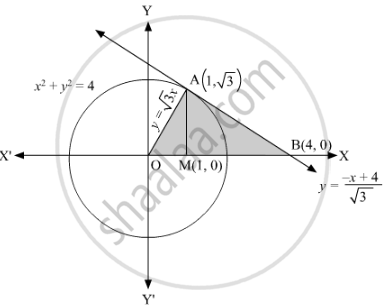
Now,
Area of ∆AOB = Area of ∆AOM + Area of ∆AMB
`=int_0^1ydx+int_1^4y dx`
`=int_0^1sqrt3xdx+int_1^4((-x+4)/sqrt3)dx`
`=[(sqrt3x^2)/2]_0^1+int_1^4-x/sqrt3dx+int_1^44/sqrt3dx`
`=(sqrt3/2-0)-[x^2/(2sqrt3)]_1^4+[4/sqrt3x]_1^4`
`=sqrt3/2-16/(2sqrt3)+1/(2sqrt3)+16/sqrt3-4/sqrt3`
`=sqrt3/2+(3sqrt3)/2`
`=2sqrt3`
Thus, the area of the triangle so formed is `2sqrt3` square units.
APPEARS IN
संबंधित प्रश्न
Find the area of the region bounded by the parabola y = x2 and y = |x| .
Area lying in the first quadrant and bounded by the circle x2 + y2 = 4 and the lines x = 0 and x = 2 is ______.
Find the area between the curves y = x and y = x2
Find the area of the region lying in the first quadrant and bounded by y = 4x2, x = 0, y = 1 and y = 4
Sketch the graph of y = |x + 3| and evaluate `int_(-6)^0 |x + 3|dx`
Find the area of the smaller region bounded by the ellipse `x^2/9 + y^2/4` and the line `x/3 + y/2 = 1`
Using the method of integration, find the area of the triangle ABC, coordinates of whose vertices are A (4 , 1), B (6, 6) and C (8, 4).
Find the area bounded by the circle x2 + y2 = 16 and the line `sqrt3 y = x` in the first quadrant, using integration.
Find the area of the smaller region bounded by the ellipse \[\frac{x^2}{9} + \frac{y^2}{4} = 1\] and the line \[\frac{x}{3} + \frac{y}{2} = 1 .\]
Draw a rough sketch and find the area bounded by the curve x2 = y and x + y = 2.
Find the area of the region.
{(x,y) : 0 ≤ y ≤ x2 , 0 ≤ y ≤ x + 2 ,-1 ≤ x ≤ 3} .
Find the area of the region bounded by the following curve, the X-axis and the given line:
y = 2 – x2, x = –1, x = 1
Choose the correct alternative:
Using the definite integration area of the circle x2 + y2 = 16 is ______
State whether the following statement is True or False:
The area bounded by the curve y = f(x) lies on the both sides of the X-axis is `|int_"a"^"b" "f"(x) "d"x| + |int_"b"^"c" "f"(x) "d"x|`
Find the area of the region bounded by the curve 4y = 7x + 9, the X-axis and the lines x = 2 and x = 8
Find area of the region bounded by 2x + 4y = 10, y = 2 and y = 4 and the Y-axis lying in the first quadrant
Find area of the region bounded by the parabola x2 = 36y, y = 1 and y = 4, and the positive Y-axis
Find the area of the circle x2 + y2 = 62
The area enclosed between the curve y = loge(x + e) and the coordinate axes is ______.
Area bounded by the curve xy = 4, X-axis between x = 1, x = 5 is ______.
Find the area between the two curves (parabolas)
y2 = 7x and x2 = 7y.
The area (in sq.units) of the part of the circle x2 + y2 = 36, which is outside the parabola y2 = 9x, is ______.
Area bounded by the curves y = `"e"^(x^2)`, the x-axis and the lines x = 1, x = 2 is given to be α square units. If the area bounded by the curve y = `sqrt(ℓ "n"x)`, the x-axis and the lines x = e and x = e4 is expressed as (pe4 – qe – α), (where p and q are positive integers), then (p + q) is ______.
The area bounded by the curve, y = –x, X-axis, x = 1 and x = 4 is ______.
The area bounded by the curve `y = 3/2sqrtx`, the line x = 1 and x-axis is ______ sq. units.
Which standard form corresponds to a region bounded by the \[y\]-axis?
Why is the area enclosed by \[\frac{x^2}{a^2}+\frac{y^2}{b^2}=1\] written as \[4\int_0^a y\,dx\]?
