Advertisements
Advertisements
प्रश्न
Using Euler’s formula, find the unknown.
| Faces | ? | 5 | 20 |
| Vertices | 6 | ? | 12 |
| Edges | 12 | 9 | ? |
Advertisements
उत्तर
By Euler’s formula, we have
F + V − E = 2
(i) F + 6 − 12 = 2
F − 6 = 2
F = 8
(ii) 5 + V − 9 = 2
V − 4 = 2
V = 6
(iii) 20 + 12 − E = 2
32 − E = 2
E = 30
Thus, the table can be completed as
| Faces | 8 | 5 | 20 |
| Vertices | 6 | 6 | 12 |
| Edges | 12 | 9 | 30 |
shaalaa.com
या प्रश्नात किंवा उत्तरात काही त्रुटी आहे का?
संबंधित प्रश्न
Is it possible to have a polyhedron with any given number of faces? (Hint: Think of a pyramid).
Draw net for the following polyhedron :
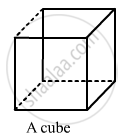
Draw net for the following polyhedron :
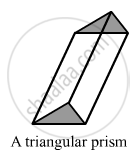
Draw at least three different nets for making a cube.
Using Euler’s formula, find the values of a, b, c and d.
| Faces | a | 5 | 20 | 6 |
| Vertices | 6 | b | 12 | d |
| Edges | 12 | 9 | c | 12 |
How many faces does the following solid have?
Octahedron
The corners of solid shapes are called its ______.
A cylinder has no vertex.
How many faces does a cylinder have?
The corner points where edges of a solid meet are called:
