Advertisements
Advertisements
प्रश्न
Using Euler’s formula, find the unknown.
| Faces | ? | 5 | 20 |
| Vertices | 6 | ? | 12 |
| Edges | 12 | 9 | ? |
Advertisements
उत्तर
By Euler’s formula, we have
F + V − E = 2
(i) F + 6 − 12 = 2
F − 6 = 2
F = 8
(ii) 5 + V − 9 = 2
V − 4 = 2
V = 6
(iii) 20 + 12 − E = 2
32 − E = 2
E = 30
Thus, the table can be completed as
| Faces | 8 | 5 | 20 |
| Vertices | 6 | 6 | 12 |
| Edges | 12 | 9 | 30 |
संबंधित प्रश्न
Is it possible to have a polyhedron with any given number of faces? (Hint: Think of a pyramid).
The given Figure are prisms or not?
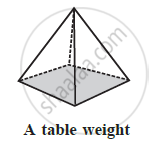
Can a polyhedron have for its face 3 triangles?
Can a polyhedron have for its face 4 triangles?
The following figure, given below, shows shadows of some 3D object when seen under the lamp of an overhead projector:
Verify Euler’s formula for the table given below.
| Faces | Verticles | Edges |
| 4 | 4 | 6 |
Using Euler’s formula, find the unknowns.
| Faces | Vertices | Edges |
| 8 | ? | 10 |
Find the number of faces in the given shape:
A solid that has only one vertex is ______.
Which 3D solid has no vertices and no edges?
