Advertisements
Advertisements
प्रश्न
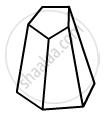
Verify Euler's formula for the following polyhedron:
Advertisements
उत्तर
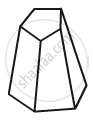
In the given polyhedron:
Edges E=15
Faces F=7
Vertices V=10
Now, putting these values in Euler's formula:
LHS: F+V
= 7+10
= 17
LHS: E + 2
= 15 + 2
= 17
LHS = RHS
Hence, the Euler's formula is satisfied.
संबंधित प्रश्न
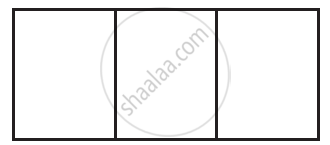
Here is an incomplete net for making a cube. Complete it in at least two different ways. Remember that a cube has six faces. How many are there in the net here? (Give two separate diagrams. If you like, you may use a squared sheet for easy manipulation.)
Can a polyhedron have for its face a square and four triangles?
Is it possible to have a polyhedron with any given number of faces?
State, the number of faces, number of vertices and number of edges of:
(i) a pentagonal pyramid
(ii) a hexagonal prism
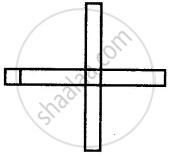
The following figure represent the nets of some solid. Name the solid
Identify if the following net can be used to form a cube:

The following figure, given below, shows shadows of some 3D object when seen under the lamp of an overhead projector:
Verify Euler’s formula for the table given below.
| Faces | Vertices | Edges |
| 32 | 60 | 90 |
Find the number of faces in the given shape:
The common portion of two adjacent faces of a cuboid is called ______.
