Advertisements
Advertisements
प्रश्न
Using electron-dot diagrams which show only the outermost shell electrons, show how a molecule of oxygen, O2, is formed from two oxygen atoms. What name is given to this type of bonding? (At. No. of oxygen = 8)
Advertisements
उत्तर
The atomic number of oxygen is 8. Its electronic configuration is 2, 6. Hence it has six electrons in its outermost shell.

In an oxygen molecule, one oxygen atom shares its two electrons with another oxygen atom. Hence this type of bonding is called covalent bonding.
APPEARS IN
संबंधित प्रश्न
Why covalent compounds are different from ionic compounds?
Name the type of bonds formed in ionic compounds and in the compounds formed by carbon.
Buckminsterfullerene is spherical molecule in which 60 carbon atoms are arranged in interlocking hexagonal and pentagonal rings of carbon atoms.
How many hexagons of carbon atoms are present in one molecule of buckminsterfullerene?
Which inert gas does the Cl atom in HCl resemble in electron arrangement?
Draw the electron-dot structure of N2 and state the type of bonding.
The molecules having triple bond in them are:
(a) oxygen and ethyne
(b) carbon dioxide and ammonia
(c) methane and ethene
(d) nitrogen and ethyne
What do you understand by polar covalent compounds?
Draw an electron dot structure of the following molecule. (Without showing the circle) :
Water
Explain the Structural isomerism term with example.
Choose and write the correct option.
Which type of carbon-carbon bonds are present in Vanaspati ghee?
Give examples for the following:
Two solid covalent compounds.
Explain the structure of Hydronium ion.
Choose the correct answer from the options given below
Condition favorable for formation of a covalent bond is
(a) Compound X consists of molecules.
Choose the letter corresponding to the correct answer from the choices (a), (b), (c) and (d) given below
In the liquid state, X will
Element A has 2 electrons in its M shell. Element B has atomic number 7.
Write equations to show how A and B form ions.
Name two compounds that are covalent when taken pure but produce ions when dissolved in water.
Name two compounds that are covalent when taken pure but produce ions when dissolved in water.
Complete the following activity.
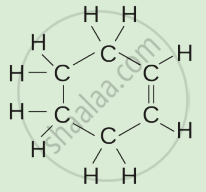
Write the names of the hydrocarbons for the following structural formula.
(isobutylene, cyclohexane, propene, cyclohexene, cyclopentane, benzene, propyne, isobutane, propane)
 |
Two carbon atoms can always form one or two covalent bonds.
The number of single and double bonds present in a molecule of benzene (C6H6) respectively, are ______.
