Advertisements
Advertisements
प्रश्न
Using the distance formula, show that the given points are collinear:
(6, 9), (0, 1) and (-6, -7)
Advertisements
उत्तर
Let A( 6,9) ,B( 0,1 ) and C (-6, -7) be the give points. Then
`AB = sqrt((0-6)^2 +(1-9)^2 )= sqrt((-6)^2 +(-8)^2) = sqrt(36 + 64)= sqrt(100)`=10 units
`BC=sqrt((-6-0)^2+(-7-1)^2) = sqrt((-6)^2+(-8)^2)= sqrt(36 + 64)= sqrt(100) `=10 units
`AC = sqrt((-6-6)^2 +(-7-9)^2 )= sqrt((-12)^2 +(16)^2) = sqrt(144 + 256 )= sqrt(400)`= 20 units
∴ AB + BC = (10+10) units - 20 units = AC
Hence, the given points are collinear
APPEARS IN
संबंधित प्रश्न
Determine if the points (1, 5), (2, 3) and (−2, −11) are collinear.
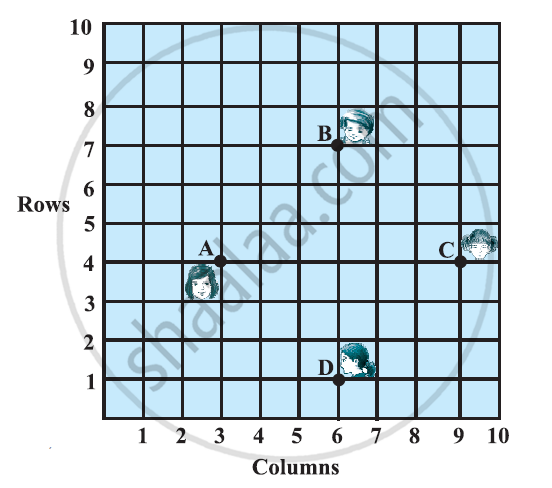
In a classroom, 4 friends are seated at the points A, B, C and D as shown in the following figure. Champa and Chameli walk into the class and after observing for a few minutes, Champa asks Chameli, “Don’t you think ABCD is a square?” Chameli disagrees.
Using distance formula, find which of them is correct.
If the distance between the points (4, k) and (1, 0) is 5, then what can be the possible values of k?
ABC is a triangle and G(4, 3) is the centroid of the triangle. If A = (1, 3), B = (4, b) and C = (a, 1), find ‘a’ and ‘b’. Find the length of side BC.
Prove that the points A(1, 7), B (4, 2), C(−1, −1) D (−4, 4) are the vertices of a square.
Show that the ▢PQRS formed by P(2, 1), Q(–1, 3), R(–5, –3) and S(–2, –5) is a rectangle.
If the point P(2, 1) lies on the line segment joining points A(4, 2) and B(8, 4), then ______.
Find the distance between the following point :
(p+q,p-q) and (p-q, p-q)
Find the distance between the following point :
(sin θ , cos θ) and (cos θ , - sin θ)
The distance between the points (3, 1) and (0, x) is 5. Find x.
Show that the point (0, 9) is equidistant from the points (–4, 1) and (4, 1).
AOBC is a rectangle whose three vertices are A(0, 3), O(0, 0) and B(5, 0). The length of its diagonal is ______.
A circle drawn with origin as the centre passes through `(13/2, 0)`. The point which does not lie in the interior of the circle is ______.
Case Study -2
A hockey field is the playing surface for the game of hockey. Historically, the game was played on natural turf (grass) but nowadays it is predominantly played on an artificial turf.
It is rectangular in shape - 100 yards by 60 yards. Goals consist of two upright posts placed equidistant from the centre of the backline, joined at the top by a horizontal crossbar. The inner edges of the posts must be 3.66 metres (4 yards) apart, and the lower edge of the crossbar must be 2.14 metres (7 feet) above the ground.
Each team plays with 11 players on the field during the game including the goalie. Positions you might play include -
- Forward: As shown by players A, B, C and D.
- Midfielders: As shown by players E, F and G.
- Fullbacks: As shown by players H, I and J.
- Goalie: As shown by player K.
Using the picture of a hockey field below, answer the questions that follow:

The point on y axis equidistant from B and C is ______.
The points (– 4, 0), (4, 0), (0, 3) are the vertices of a ______.
What type of a quadrilateral do the points A(2, –2), B(7, 3), C(11, –1) and D(6, –6) taken in that order, form?
Find the value of a, if the distance between the points A(–3, –14) and B(a, –5) is 9 units.
The point P(–2, 4) lies on a circle of radius 6 and centre C(3, 5).
If the point A(2, – 4) is equidistant from P(3, 8) and Q(–10, y), find the values of y. Also find distance PQ.
Read the following passage:
|
Use of mobile screen for long hours makes your eye sight weak and give you headaches. Children who are addicted to play "PUBG" can get easily stressed out. To raise social awareness about ill effects of playing PUBG, a school decided to start 'BAN PUBG' campaign, in which students are asked to prepare campaign board in the shape of a rectangle: One such campaign board made by class X student of the school is shown in the figure.
|
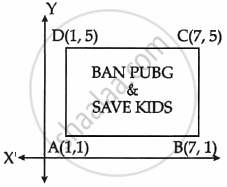
Based on the above information, answer the following questions:
- Find the coordinates of the point of intersection of diagonals AC and BD.
- Find the length of the diagonal AC.
-
- Find the area of the campaign Board ABCD.
OR - Find the ratio of the length of side AB to the length of the diagonal AC.
- Find the area of the campaign Board ABCD.
