Advertisements
Advertisements
प्रश्न
Use product `[(1,-1,2),(0,2,-3),(3,-2,4)][(-2,0,1),(9,2,-3),(6,1,-2)]` to solve the system of equations x + 3z = 9, −x + 2y − 2z = 4, 2x − 3y + 4z = −3
Advertisements
उत्तर
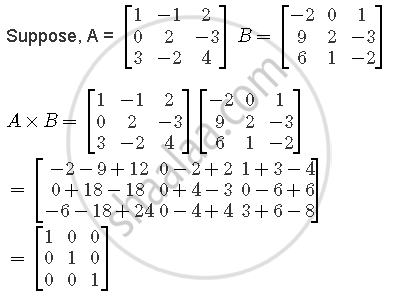
Since, A × B = I,
∴ B = A−1 .....(1)
Now, the given system of equations is
x + 3z = 9
−x + 2y − 2z = 4
2x − 3y + 4z = −3
This can also be represented as,
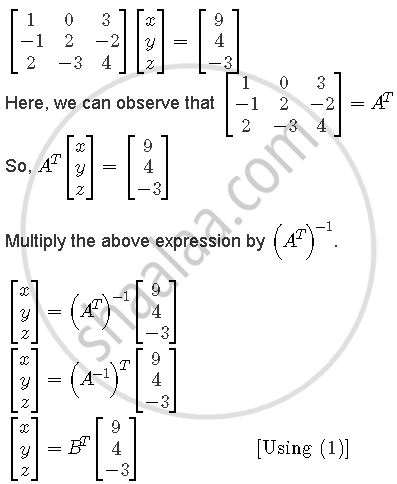
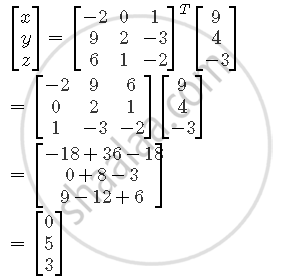
Hence, x = 0, y = 5 and z = 3.
APPEARS IN
संबंधित प्रश्न
If A is a square matrix such that A2 = I, then find the simplified value of (A – I)3 + (A + I)3 – 7A.
If A = `[(0, -tan α/2), (tan α/2, 0)]` and I is the identity matrix of order 2, show that I + A = `(I - A)[(cos α, -sin α),(sin α, cos α)]`
if A = [(1,1,1),(1,1,1),(1,1,1)], Prove that A" = `[(3^(n-1),3^(n-1),3^(n-1)),(3^(n-1),3^(n-1),3^(n-1)),(3^(n-1),3^(n-1),3^(n-1))]` `n in N`
If li, mi, ni, i = 1, 2, 3 denote the direction cosines of three mutually perpendicular vectors in space, prove that AAT = I, where \[A = \begin{bmatrix}l_1 & m_1 & n_1 \\ l_2 & m_2 & n_2 \\ l_3 & m_3 & n_3\end{bmatrix}\]
If\[A = \begin{bmatrix}2 & 3 \\ 4 & 5\end{bmatrix}\]prove that A − AT is a skew-symmetric matrix.
Classify the following matrix as, a row, a column, a square, a diagonal, a scalar, a unit, an upper triangular, a lower triangular, a symmetric or a skew-symmetric matrix:
`[9 sqrt(2) -3]`
Classify the following matrix as, a row, a column, a square, a diagonal, a scalar, a unit, an upper triangular, a lower triangular, a symmetric or a skew-symmetric matrix:
`[(3, 0, 0),(0, 5, 0),(0, 0, 1/3)]`
Find k if the following matrix is singular:
`[(4, 3, 1),(7, "k", 1),(10, 9, 1)]`
Find k if the following matrix is singular:
`[("k" - 1, 2, 3),(3, 1, 2),(1, -2, 4)]`
If A = `[(5, 1, -1),(3, 2, 0)]`, Find (AT)T.
Answer the following question:
If A = diag [2 –3 –5], B = diag [4 –6 –3] and C = diag [–3 4 1] then find B + C – A
State whether the following statement is True or False:
If A is non singular, then |A| = 0
AB = AC ⇒ B = C for any three matrices of same order.
Show by an example that for A ≠ O, B ≠ O, AB = O
If the matrix A `= [(5,2,"x"),("y",2,-3),(4, "t",-7)]` is a symmetric matrix, then find the value of x, y and t respectively.
The matrix `[(0,5,-7),(-5,0,11),(7,-11,0)]` is ____________.
The matrix `[(0,-5,8),(5,0,12),(-8,-12,0)]` is a ____________.
`[(5sqrt(7) + sqrt(7)) + (4sqrt(7) + 8sqrt(7))] - (19)^2` = ?
A matrix is said to be a row matrix, if it has
A square matrix B = [bÿ] m × m is said to be a diagonal matrix if all diagonal elements are
A = `[a_(ij)]_(m xx n)` is a square matrix, if
If `[(1, 2, 1),(2, 3, 1),(3, a, 1)]` is non-singular matrix and a ∈ A, then the set A is ______.
If A is a square matrix of order 3, then |2A| is equal to ______.
Which general form represents a row matrix?
If \[m=n\], what type and order does the matrix have?
A diagonal matrix is a square matrix in which:
What role does the zero matrix play in matrix algebra?
