Advertisements
Advertisements
प्रश्न
Two mobiles cost 16,000 rupees. How much money will be required to buy 13 such mobiles?
Advertisements
उत्तर
Let us suppose the cost of 13 mobiles is x rupees.
The number of mobiles and their cost vary in direct proportion.
∴ `2/16000 = 13/x`
⇒ x = `(13 xx 16000)/2`
x = ₹ 1,04,000
Hence, the cost of 13 mobiles is ₹ 1,04,000.
संबंधित प्रश्न
Complite the following table given that x varies directly as y .
| x | 6 | 8 | 10 | ... | 20 |
| y | 15 | 20 | ... | 40 | ... |
A and B can do a piece of work in 18 days; B and C in 24 days and A and C in 36 days. In what time can they do it, all working together?
Every 3 months Tamilselvan deposits ₹ 5000 as savings in his bank account. In how many years he can save ₹ 1,50,000
Assuming land to be uniformly fertile, the area of land and the yield on it vary ______
If two quantities x and y vary directly with each other, then ______
Both x and y vary directly with each other and when x is 10, y is 14, which of the following is not a possible pair of corresponding values of x and y?
On increasing a, b increases in such a manner that `a/b` remains ______ and positive, then a and b are said to vary directly with each other.
The area of cultivated land and the crop harvested is a case of direct proportion.
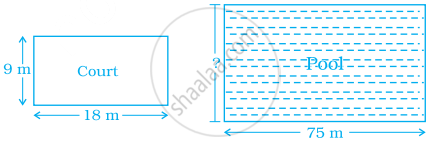
A volleyball court is in a rectangular shape and its dimensions are directly proportional to the dimensions of the swimming pool given below. Find the width of the pool.
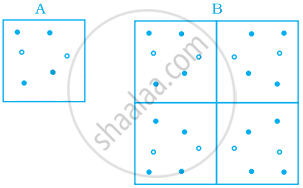
Pattern B consists of four tiles like pattern A. Write a proportion involving red dots and blue dots in pattern A and B. Are they in direct proportion? If yes, write the constant of proportion.