Advertisements
Advertisements
प्रश्न
Think and answer in your own words.
Why does the writer begin by quoting the lines from William Blake's poem 'Auguries of Innocence'?
Advertisements
उत्तर
These lines show that if we pause to reflect. there is much beauty in nature and plenty that we can learn from it. The write-up expands on the same idea. thus reflecting the philosophy of the poetic lines by William Blake.
APPEARS IN
संबंधित प्रश्न
Various aspects of Nature have special features that make them differ from one another.
For example, Birds:- appearance, shape, colour, size, food habits, habitat, sound etc.
Write such special features of each of the following.
- Land- _______________
- Water- ______________
- Trees- _______________
- Animals- ____________
- Insects- _____________
Think and answer in your own words.
‘An oyster turns a grain of sand into a pearl.’ What can we learn from this example?
'Impossible' itself says 'I M possible'. Do you agree? Justify your answer by citing something that you have experienced or heard from someone.
Divide the class into five groups. Discuss in the group the following points. Give one point to each group.
- Seeds regerminate from another seed.
- Plants and flowers wilt and become one with the earth.
- Cactii thrive in the desert region.
- Bare nature turns green in spring.
- Caterpillar turns into butterfly.
Each group will present their discussion in front of the class.
Look at the following thing. Discuss with your friend, what you learn from them.
A creeper
Look at the following things. Discuss with your friend, what you learn from them.
The river
Look at the following things. Discuss with your friend, what you learn from them.
Rainfall
Impossible itself says ‘I M possible’. Do you agree? Justify your answer by citing some examples from the text and some that you have experienced or heard from someone.
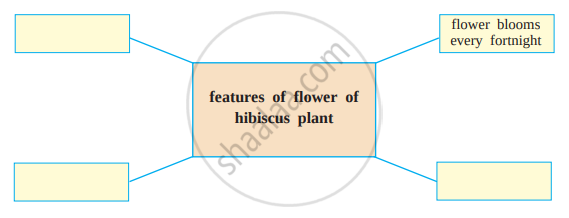
Go through the text again and complete the web that highlights the various features of flower of the ‘hibiscus’ plant. One is done for you.
The author has very positively described the different things in nature. Discuss with your partner the special features of each one of them. Add on the list.
| Part of Nature | Special Feature | Value Learnt |
| 1. Water | ||
| 2. Rainbow | ||
| 3. Caterpillar | ||
| 4. | ||
| 5. | ||
| 6. | ||
| 7. | ||
| 8. | ||
| 9. | ||
| 10. |
