Advertisements
Advertisements
प्रश्न
The side (in cm) of a triangle containing the right angle are 5x and 3x – 1. If the area of the triangle is 60 cm². Find the sides of the triangle.
Advertisements
उत्तर
Area of the right triangle ABC
= `(5x (3x - 1))/(2)`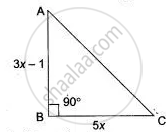
∴ `(5x (3x - 1))/(2)` = 60
⇒ 15x2 - 5x = 120
⇒ 3x2 - x = 24
⇒ 3x2 - x - 24 = 0
⇒ 3x2 - 9x + 8x - 24 = 0
⇒ 3x(x - 3) + 8(x - 3) = 0
⇒ (x - 3) (3x + 8) = 0
⇒ x - 3 = 0 or 3x + 8 = 0
⇒ x = 3 or x = `(-8)/(3)`
But x = `(-8)/(3)` is not possible as isde cannot be - ve.
Then x = 3.
Hence, sides are AB = 3x - 1 = 8 cm
BC = 5x = 15 cm
Also from AC
= `sqrt(("AB")^2 + ("BC")^2)`
= `sqrt(64 + 225)`
= `sqrt(289)`
= 17 cm.
संबंधित प्रश्न
Solve for x
`(x - 1)/(2x + 1) + (2x + 1)/(x - 1) = 2, "where x" != -1/2, 1`
Solve the following quadratic equations by factorization:
`2/2^2-5/x+2=0`
The perimeter of a rectangular field is 82 m and its area is 400 m2. Find the breadth of the rectangle.
Some students planned a picnic. The budget for food was Rs. 500. But, 5 of them failed to go and thus the cost of food for each member increased by Rs. 5. How many students attended the picnic?
Solve each of the following equations by factorization:
`x+1/x=2.5`
Divide 57 into two parts whose product is 680.
Solve the following quadratic equation using formula method only
x2 - 6x + 4 = 0
A two digit number is such that its product of its digit is 18. When 63 is subtracted from the number, the digits interchange their places. Find the number.
In each of the following, determine whether the given values are solution of the given equation or not:
x2 - 3x + 2 = 0; x = 2, x = -1
Solve the following equation by factorization
`(x + 2)/(x + 3) = (2x - 3)/(3x - 7)`
