Advertisements
Advertisements
प्रश्न
The radius of a hemispherical balloon increases from 6 cm to 12 cm as air is being pumped into it. The ratios of the surface areas of the balloon in the two cases is ______.
पर्याय
1 : 4
1 : 3
2 : 3
2 : 1
Advertisements
उत्तर
The radius of a hemispherical balloon increases from 6 cm to 12 cm as air is being pumped into it. The ratios of the surface areas of the balloon in the two cases is 1 : 4.
Explanation:
Given that radius of a hemispherical balloon (r1) = 6 cm
Since, air is pumped into balloon.
Then, radius of hemispherical balloon (r2) = 12 cm
∴ Ratio of the surface areas of the balloon in both cases = `(3pir_1^2)/(3pir_2^2)`
`\implies r_1^2/r_2^2 = (6)^2/(12)^2`
= `36/144`
= `1/4`
= 1 : 4
Hence, ratio of the surface areas of the balloon in the two cases is 1 : 4.
APPEARS IN
संबंधित प्रश्न
Two solid spheres of radii 2 cm and 4 cm are melted and recast into a cone of height 8 cm. Find the radius of the cone so formed.
Metallic spheres of radii 6 cm, 8 cm and 10 cm respectively are melted and recasted into a single solid sphere. Taking π = 3.1, find the surface area of the solid sphere formed.
Spherical marbles of diameter 1.4 cm are dropped into beaker containing some water and are fully submerged. The diameter of the beaker is 7 cm. Find how many marbles have been dropped in it if the water rises by 5.6 cm.
A largest sphere is to be carved out of a right circular cylinder of radius 7 cm and height 14 cm. Find the volume of the sphere.
A solid is in the form of a cone standing on a hemi-sphere with both their radii being equal to 8 cm and the height of cone is equal to its radius. Find, in terms of π, the volume of the solid.
Find the total surface area of a hemisphere of radius 10 cm.
Find the radius of a sphere whose surface area is 154 cm2.
If a hollow sphere of internal and external diameters 4 cm and 8 cm respectively melted into a cone of base diameter 8 cm, then find the height of the cone.
The total surface area of a hemisphere of radius r is
The largest sphere is cut off from a cube of side 6 cm. The volume of the sphere will be
If a sphere is inscribed in a cube, then the ratio of the volume of the sphere to the volume of the cube is
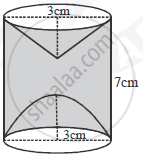
A hemispherical and a conical hole is scooped out of a.solid wooden cylinder. Find the volume of the remaining solid where the measurements are as follows:
The height of the solid cylinder is 7 cm, radius of each of hemisphere, cone and cylinder is 3 cm. Height of cone is 3 cm.
Give your answer correct to the nearest whole number.Taken`pi = 22/7`.
The model of a building is constructed with the scale factor 1 : 30.
(i) If the height of the model is 80 cm, find the actual height of the building in meters.
(ii) If the actual volume of a tank at the top of the building is 27m3, find the volume of the tank on the top of the model.
Find the surface area and volume of sphere of the following radius. (π = 3.14 )
3.5 cm
Find the length of the wire of diameter 4 m that can be drawn from a solid sphere of radius 9 m.
The internal and external diameters of a hollow hemi-spherical vessel are 21 cm and 28 cm respectively. Find volume of material of the vessel.
A spherical cannon ball, 28 cm in diameter is melted and recast into a right circular conical mould, the base of which is 35 cm in diameter. Find the height of the cone, correct to one place of decimal.
The radius of a sphere is 10 cm. If we increase the radius 5% then how many % will increase in volume?
The total surface area of a hemisphere is how many times the square of its radius
