Advertisements
Advertisements
प्रश्न
A hemispherical bowl of internal radius 9 cm is full of liquid. This liquid is to be filled into conical shaped small containers each of diameter 3 cm and height 4 cm. How many containers are necessary to empty the bowl?
Advertisements
उत्तर
Radius of hemispherical bowl = 9 cm
Volume = `1/2 xx 4/3pir^3`
= `2/3pi9^3`
= `2/3pi xx 729`
= 486π cm3
Diameter each of cylindrical bottle = 3 cm
Radius = `3/2` cm and height = 4 cm
∴ Volume of bottle = `1/3pir^2h`
= `1/3pi xx (3/2)^2 xx 4`
= 3π
∴ No. of bottles = `(486pi)/(3pi) = 162`
APPEARS IN
संबंधित प्रश्न
Find the surface area of a sphere of diameter 21 cm.
`["Assume "pi=22/7]`
Find the surface area of a sphere of diameter 3.5 m.
`["Assume "pi=22/7]`
The surface area of a solid metallic sphere is 2464 cm2. It is melted and recast into solid right circular cones of radius 3.5 cm and height 7 cm. Calculate:
- the radius of the sphere.
- the number of cones recast. (Take π = `22/7`)
Total volume of three identical cones is the same as that of a bigger cone whose height is 9 cm and diameter 40 cm. Find the radius of the base of each smaller cone, if height of each is 108 cm.
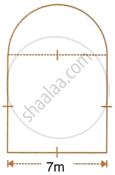
The cross-section of a tunnel is a square of side 7 m surmounted by a semi-circle as shown in the adjoining figure. The tunnel is 80 m long.
Calculate:
- its volume,
- the surface area of the tunnel (excluding the floor) and
- its floor area.
The hollow sphere, in which the circus motor cyclist performs his stunts, has a diameter of 7 m. Find the area available to the motorcyclist for riding.
The ratio between the volume of a sphere and volume of a circumscribing right circular cylinder is
The surface area of a solid metallic sphere is 616 cm2. It is melted and recast into smaller spheres of diameter 3.5 cm. How many such spheres can be obtained?
The radius of a hemispherical balloon increases from 6 cm to 12 cm as air is being pumped into it. The ratios of the surface areas of the balloon in the two cases is ______.
A manufacturing company prepares spherical ball bearings, each of radius 7 mm and mass 4 gm. These ball bearings are packed into boxes. Each box can have a maximum of 2156 cm3 of ball bearings. Find the:
- maximum number of ball bearings that each box can have.
- mass of each box of ball bearings in kg.
(Use π = `22/7`)
