Advertisements
Advertisements
प्रश्न
The pulley system shown in the figure is to be used to lift a load W. If the man applying the effort cannot apply a force exceeding 1000 N, what is the maximum load that can be lifted?
The actual load that the man is finally able to lift turns out to be 2700 N. What are the values of the actual M.A., obtained, and the efficiency of the actual set-up?
Advertisements
उत्तर
The load lifted would be a maximum when conditions are ideal. Since this set-up uses three strands of string, the load gets raised only through 1/3rd of the distance through which the effort moves.
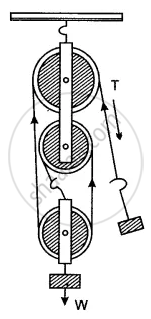
Hence,
Velocity ratio =`("Distance moved by the effort")/("Distance moved by the load")`
`=1/(1//3)=3.`
Under ideal conditions, V.R. = M.A.
Hence, Ideal M.A. of the set-up = 3.
∴ Maximum load that can be lifted = Effort × 3 = 100 N × 3
= 3000 N.
Under actual conditions, M.A. =`"Load"/"Effort"`
=`(2700"N")/(1000"N")`
= 2.7
Efficiency = `"M.A."/"V.R."=2.7/3`
= 0.9 = 90%.
संबंधित प्रश्न
Is the above pulley system an ideal machine or not?
What is a pulley?
The diagram below shows an arrangement of three pulleys A, B, and C. The load is marked as L and the effort as E.
- Name the Pulleys A, B, and C.
- Mark in the diagram the directions of load (L), effort (E) and tension T1 and T2 in the two strings.
- How are the magnitudes of L and E related to the tension T1?
- Calculate the mechanical advantage and velocity ratio of the arrangement.
- What assumptions have you made in parts (c) and (d)?

Give reason for the following:
The lower block of a block and tackle pulley system must be of negligible weight
The diagram below shows a pulley arrangement :
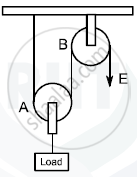
(i) Copy the diagram and mark the direction of tension on each strand of the string.
(ii) What is the velocity ratio of the arrangement ?
(iii) If the tension acting on the string is T, then what is the relationship between T and effort E ?
(iv) If the free end of the string moves through distance x, find the distance by which the load is raised.
What is a block and tackle system of pulleys?
Name a machine which is used to:
change the direction of force applied.
Fig shown a block and tackles system of pulleys used to lift a load.
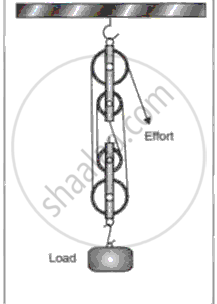
(i) How many strands of tackle are supporting the load?
(ii) Draw arrows to represent tension in each stand.
(iii) What is the mechanical advantage of the system?
(iv) When load is pulled up by a distance 1 m how far does the effort end move?
What is a block and tackle system of pulleys?
What is a block and tackle system of pulleys? What precautions would you observe while rounding the string so that the effort is applied in the downward direction?
